

Ho Chi Minh City, still widely known as Saigon, is Vietnam’s most important commercial center and one of Southeast Asia’s most active urban markets. For foreign companies exploring Vietnam, the city is often the first place to study, visit, and test before making a larger commitment.
After the 2025 administrative expansion, Ho Chi Minh City became a much larger economic region, combining the city’s traditional commercial core with the industrial strength of Binh Duong and the port and logistics advantages of Ba Ria-Vung Tau. The expanded city now covers more than 6,772 square kilometers, has a population of around 14 million, and accounts for about 23.5% of Vietnam’s GDP.
Its momentum has continued into 2026. In the first quarter of 2026, Ho Chi Minh City recorded GRDP growth of 8.27%, its strongest first-quarter performance in five years. The services sector remained the main growth driver, while foreign direct investment reached nearly USD 2.9 billion in the same period.
This makes Ho Chi Minh City more than a place to live as an expat or founder. It is a serious business location for market research, sales development, local partnerships, investment, regional operations, and long-term expansion.
This guide explains why the city matters, what makes it attractive, what foreign companies should prepare before entering the market, and how to approach local execution with more clarity.
Why Ho Chi Minh City Is Vietnam’s Economic Hub
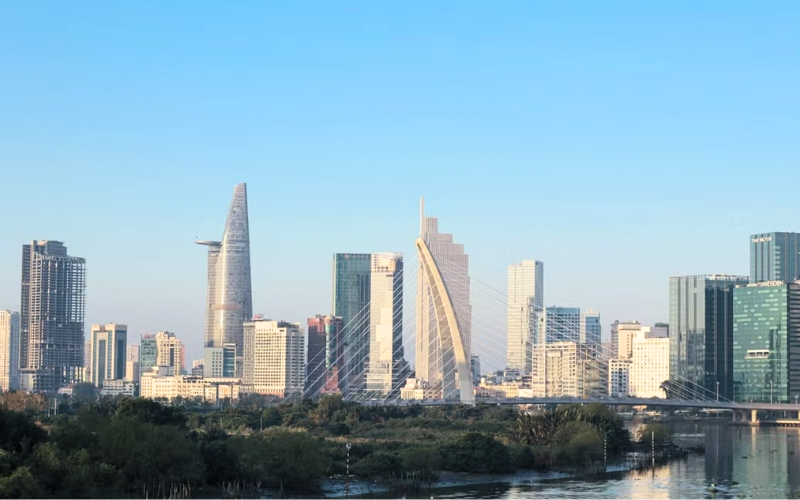
Ho Chi Minh City is often described as Vietnam’s business capital. Hanoi remains the political and administrative center, but Ho Chi Minh City leads in commercial activity, private-sector energy, foreign investment, finance, consumer demand, and international business services.
The city’s position is not built on one industry. Its economy includes trade, finance, retail, technology, logistics, real estate, manufacturing, professional services, education, healthcare, and hospitality. This diversity gives foreign businesses more ways to enter the market. A company does not need to be a manufacturer to find opportunities here. It may enter through distribution, business development, consulting, digital services, consumer products, partnerships, or regional operations.
The 2025 expansion did more than increase the city’s size. It changed the way companies should understand Ho Chi Minh City as a business location. The city is no longer only a dense commercial center built around finance, trade, and services. It now functions more like an integrated economic corridor, where head offices, industrial parks, ports, logistics networks, and consumer markets are connected within one enlarged region.
For foreign companies, this creates a more practical business environment. A company can keep its commercial team close to clients and professional services in the urban core, while exploring production capacity, warehousing, or logistics options in surrounding industrial areas. This broader structure makes Ho Chi Minh City relevant not only for sales and market entry, but also for companies planning long-term operations in southern Vietnam.
In 2025, the city recorded gross regional domestic product of around VND 3 quadrillion, equivalent to nearly USD 114.2 billion, with an annual GRDP growth rate of 8.03%. It also contributed nearly one third of Vietnam’s state budget revenue.
For foreign investors, this scale matters because it shows both market depth and business density. More customers, more companies, more suppliers, more service providers, and more professional networks are concentrated in one place. This creates a stronger ecosystem for companies that are still learning how Vietnam works.
Ho Chi Minh City is also Vietnam’s leading financial center. It is home to the Ho Chi Minh Stock Exchange and a high concentration of banks, law firms, accounting firms, investment advisors, consulting companies, and foreign business chambers. For companies that need commercial support, banking access, legal advice, recruitment services, or local introductions, the city usually offers more options than secondary locations.
Foreign direct investment is another signal of confidence. In 2026, Ho Chi Minh City set a target of attracting USD 11 billion in FDI. By the end of April, total registered FDI had already reached USD 3.3 billion, according to Department of Finance. The city is increasingly prioritizing high technology, logistics, seaports, data centers, green growth, supporting industries, and international finance.
What Makes the City Attractive for Foreign Businesses

The old view of Saigon as a vibrant place to live still has value, but for business planning, those lifestyle advantages should be translated into practical business factors. A young population becomes a workforce advantage. Affordable daily costs become more competitive operating costs. Strong urban energy becomes consumer demand. International communities become useful business networks.
One of the main attractions is talent. Ho Chi Minh City draws workers from across Vietnam. Its labor market includes sales staff, managers, engineers, logistics coordinators, marketers, designers, software developers, finance professionals, production specialists, and bilingual employees. For a foreign company entering Vietnam, this makes it easier to start with a small local team and expand gradually.
The city is especially useful for companies that need commercial roles such as country managers, sales representatives, business development executives, customer support teams, sourcing coordinators, or local operations staff. Many professionals have experience working with international companies, although English ability and management experience can vary by industry and seniority.
Companies should still be realistic. Talent is available, but experienced bilingual managers, technical specialists, and strong sales leaders can be competitive to hire. Salary expectations are rising, and employee retention requires more than basic compensation. Foreign companies need clear job scopes, realistic budgets, good onboarding, and local management practices that match the Vietnamese working environment.
Another reason the city attracts foreign companies is consumer demand. Ho Chi Minh City is one of Vietnam’s most important urban markets. Modern retail, e-commerce, convenience stores, food and beverage brands, private education, healthcare, fitness, digital services, and lifestyle products have developed quickly over the past decade.
This creates opportunities for both B2C and B2B businesses. Consumer brands can test products with a large urban audience. Service providers can support companies that are growing inside Vietnam. Technology firms can sell tools for digitalization, customer management, payments, logistics, automation, or marketing.
However, strong demand does not mean easy sales. Vietnamese consumers can be curious and fast-moving, but they are also price-conscious and influenced by trust, convenience, social proof, and local habits. Foreign companies need to adapt pricing, distribution, communication, and customer service rather than assuming that a model from another country will work unchanged.
Operating costs are another advantage. Compared with regional hubs such as Singapore or Hong Kong, Ho Chi Minh City can offer lower costs for office space, salaries, local services, and market testing. For SMEs, startups, or companies exploring market entry, this can reduce the risk of building an initial presence.
The cost advantage should not be understood as simply “cheap.” A low-cost market is only useful if it also has talent, infrastructure, business services, and customers. Ho Chi Minh City is attractive because it combines relative affordability with strong commercial activity.
Quality of life also supports business decisions. Food, housing options, international schools, coworking spaces, cafes, business events, and a large foreign community can make relocation easier for founders and foreign teams. These factors may not be the core reason to enter Vietnam, but they can help companies maintain a stable presence on the ground.
What Foreign Companies Should Know Before Entering

A formal goal needs to be set prior to investment in Ho Chi Minh City. “Market entry” is an ambiguous term and encompasses quite a few different scenarios: selling to Vietnam, establishing a representative office, recruiting employees, seeking distributors, incorporating, establishing business networks, and being operational.
All foreign companies should define the goal for their activities in Vietnam prior to entry in Ho Chi Minh City. Again, “Market entry” is ambiguous and may involve a number of different activities including demand assessment, distributor search, establishment of a representative office, hiring of staff, incorporation, and establishment of business operations.
The structure must support the goal of the business. A representative office is a good option for companies that require a local presence to conduct research, liaise, or coordinate business partners. Nevertheless, representative offices cannot engage in many business activities. Essentially a foreign-owned company gives companies more room to operate, invoice clients, hire staff, and build a long-term presence. This will, however, involve compliance with tax obligations, an accounting obligation, and a reporting obligation. In many business areas, local partnerships and joint ventures are the preferred options because of the reasons. This is especially true with regard to market access, licensing, and distribution.
Selecting a location involves additional practical considerations. Remaining as the traditional central business district, District 1 can accommodate finance, consulting, and legal services, as well as premium brands, representative offices, and client-facing teams. Within District 3 and District 4, there is varied office availability with reasonable proximity to the center. Modern office space, real estate, and finance options that can accommodate international residents, as well as the current District 2, are through Thu Thiem. District 7 has service businesses and is home to the foreign community and schools. Of note, Korean businesses find it an attractive area as well.
The old city center is rarely appropriate for manufacturing, logistics, or industrial operations. The expanded Ho Chi Minh City area provides better access for businesses to industrial zones, ports, highways, and logistics corridors, specifically the former Binh Duong and Ba Ria-Vung Tau.
The practicalities of the regulatory and administrative environment need attention at this stage as well. While Vietnam has made great strides in reforming their business infrastructure, foreign companies still need to prepare documents, understand licensing conditions, manage tax and accounting, and follow labor rules. Numerous processes are conducted in Vietnamese, with the local business culture and market conditions impacting timelines and execution.
For these reasons, many foreign businesses opt to conduct a limited validation phase, assessing the demand, cost structure and market entry options, establishing connections with potential business partners, and performing preliminary assessments on legal and operational frameworks that suit their plans.
Depending on the scale of the planned operations, businesses may need to engage several local experts, including legal, tax, accounting, and HR specialists, as well as market research and operational support services. For market entry projects especially, local partners can perform an invaluable service in linking the many strategic components of a project to front line execution.
Business Culture and Local Adaptation

Familiarity with Ho Chi Minh City’s business environment needs to extend beyond mere knowledge of the market, costs, and regulation. Understanding the nuances of Vietnam’s business environment requires foreign companies to spend time understanding the intricacies of the local business relationships, communication, and the local decision-making process.
Conducting business in Vietnam is relationship-focused, but this does not suggest that contracts and pricing and the technical capabilities do not matter. What is important to understand is that, in most cases, trust and commitment is built before business is transacted. This is especially true for local partners, suppliers, distributors and customers. They would like to see that a foreign company is serious about the market and is willing to invest time and resources in developing a long-term business relationship.
As a result, a company’s initial business meetings will be dedicated to understanding the level of commitment of the other party, their expectations, and their business culture. They will also discuss their business practices and make a concerted effort to improve the business relationship; first meetings are often not only about closing a deal. They are also about understanding expectations, working style, and commitment level.
Vietnam’s business communication tends to be relatively indirect in comparison to Western cultures in the business environment, foreign companies should avoid if silence means approval or that verbal interest means commitment to the business deal. A positive response to a proposal will also not be interpreted as the company having made a final commitment to the business deal. It is, therefore, very important to understand that business commitments in Vietnam cannot be made verbally. The key elements of a pending transaction, the decisions, and the commitments must be documented and the next steps clearly articulated, along with an invitation for questions and clarifications.
The structure of companies may greatly impact the nature of decisions. In certain organizations, the representatives discussing an issue may not include the ultimate decision-maker whereas in other establishments, the owner, other members of the senior management, the technical staff, as well as family members may be part of the decision-making process. Knowing the composition of a decision-making body may assist committing firms in reducing the chances of miscommunication and delays in the process.
Having access to local networks is vital. Commerce chambers, trade associations, and other business and trade groups and services, as well as active participation in industries, offer opportunities for gaining access to market related information and pertinent contacts. However, such relationships should be backed up by proper due diligence. A warm introduction, which is a form of reference, does not obviate the need to evaluate potential partners, carry out legal and commercial verification, and mitigate risks.
For many foreign companies, relating to the local business culture is about recognizing the localized components of the business, not about making a fundamental shift in the business model. These may impact on pricing, sales channels, payment mechanisms and terms, customer service, styles of recruitment, partnerships, and communication.
Companies able to achieve a successful synergy between the international focus and local flexibility tend to achieve a successful presence in Ho Chi Minh City.
Strengths and Weaknesses to Anticipate

Vietnam has many opportunities to offer, but foreign companies entering newly developing markets should not consider it an overly simple market. It has a strong economy, but competition is fierce.
The primary opportunities prospective businesses could take advantage of include retail, food and beverage, education, health care, technology, logistics, and financial and professional services. Growth of the middle class also provides added opportunity. There will be increasing B2B opportunities for those in Vietnam who want to improve business operations and are seeking affordable tools and processes that comply with international standards.
Another major factor is the development of physical infrastructure. Ho Chi Minh City Metro Line 1 started commercial operations in December 2024. It is nearly 20 kilometers long with 14 stations. Long Thanh International Airport is slated to begin commercial flights in the last quarter of 2026. This will ease congestion at Tan Son Nhat Airport and improve connectivity in the region.
Numerous large scale logistics projects illustrate the ambition of Ho Chi Minh City to consolidate its position as a Regional Trade Gateway. The Can Gio international transshipment port project has an invested capital of approximately USD 4.9 billion.
Additionally, businesses must prepare for challenges. Language barriers are common outside the circle of international business. Regulations are often ambiguous, and strong management is in high demand and low supply. Consumers can be fickle, and local competitors can be aggressive.
Things that can be expected to be executed quickly can actually be executed very poorly and with great time delays. Companies that enter the market unprepared can expect to spend more time fixing errors than if they entered the market properly the first time.
Take things step by step. Know the market, validate the demand, devise the correct structure, compare the best locations, meet the right people, vet your partners, and devise a plan that is pragmatic.
From Interest to Execution
Ho Chi Minh City is one of the most convenient entry points into Vietnam. It has the scale, density, talent, customers, and the infrastructure and connections that can support international business. After the 2025 expansion, the city’s role became even more important, linking commercial activity, industrial capacity, and logistics potential within a larger urban region.
The opportunity for foreign business is obvious. HCMC can be the first city to test the market, build a sales team, and recruit, build partnerships, and start business on a larger scale in the southern region of Vietnam.
Success is based on preparation. The market needs more than a good business model. Companies need to understand the demand, infrastructure, regulations, business customs, and the execution risks of Vietnam. The best approach is to have local partners as companies move from the research to action phase.
MoveToAsia makes entering Vietnam easier and makes the business decision clearer for foreign companies. We support companies who want to achieve business in Vietnam with structured opportunities from market research, local business support and practical partner identification, and execution.
For companies considering this market, the key question is not whether the city matters. It is how to enter properly, operate effectively, and build a presence that can grow with Vietnam’s next stage of development.