


Cambodia has made great strides to become a hub for Foreign Direct Investment (FDI), notably from its position in Southeast Asia, value for cost, growing consumer base, and strong economic advancement. Manufacturing, logistics, real estate, tourism, and business services investors are looking to Cambodia to strengthen regional diversification.
Investing in Cambodia requires more than identifying favorable industry presence. Optimal location affects labor, transport, operating costs, regulations, and potential future profit. Industrial designs prioritize different things than professional services.
This has made site selection a strong aspect of planning. When coupled with professional site selection, investment advisors reduce the likelihood and size of poor investment decisions. This paper assesses the investment climate, principal business locations, site selection, and advisory services in Cambodia.
Cambodia’s Investment Landscape in 2026
Cambodia strives to be an attractive investment opportunity in Southeast Asia. In the last ten years, the investments that have come to Cambodia have been in manufacturing, logistics, construction, tourism, and other service sectors. It can be attributed to the reforms and changes made in the economy, as well as the trade and integration of the country’s infrastructure.
From the data provided from the CDC, foreign investment creates a lot of economic gain for Cambodia. Foreign investment, especially, is seen in the fields of exporting and infrastructure development. The international investment opportunities that Cambodia is tied to, through the agreements and treaties of Cambodia, have also provided a lot of incentive for foreign investment.
Of all the investment landscapes, manufacturing continues to be important. Garment and footwear manufacturing have the most investments, but other manufacturing fields have started to receive foreign investment. These include electronics, automotive components, consumer goods, and light manufacturing. Cambodia is continually being integrated into new regional and international manufacturing supply chains.
New investment opportunities are seen in logistics and trade, mainly because of the growing trade and transportation infrastructure. Roads, ports, and other large investments have improved the movement of goods in and out of Cambodia.
Other sectors have investments in tourism and other service sectors. Real estate, especially commercial, along with retail and other financial services, has investments because of the growing middle class in Phnom Penh.
Cambodia’s government has developed investment incentives through tax benefits and CDC support. These incentives aim to improve investment within sectors that work towards driving the economy, increasing employment and growing exports.
However, it is not enough for investors to just identify an appealing sector. Their next obstacle is determining investments’ location. Different sectors require differing combinations of labor, infrastructure, logistics, and market access. Due to this, location plays an important role for those looking to invest in Cambodia.
The premise to consider for investors is there is no single ‘best’ location for a business. The location that is the best fit will be dictated by the industry of the company, the operational needs, the supply chain, and the company’s future and growth aspirations.
Key Investment Locations and Industrial Hubs
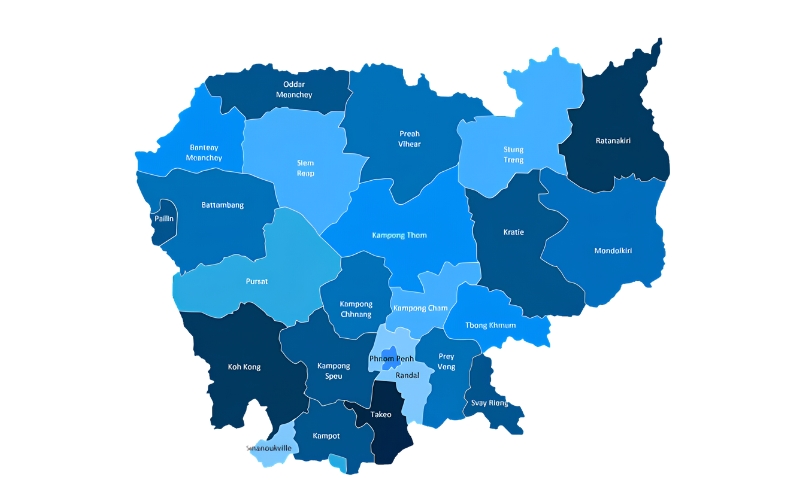
Cambodia has potential investment opportunities across the country, each having unique pros. Recognizing the benefits of each will assist the investor in choosing the right location that aligns with the requirements of their operations and growth potential of their business.
Phnom Penh
Phnom Penh is the main business and administrative hub of the country. The city is home to all government ministries, large MNCs, banks, business service firms, and most of the business associations. Also, most consulting firms and firms that deal with technology, finance, and trade, as well as corporate and regional headquarters, have operations in Phnom Penh, as the city has the best access to skilled labor and business as well as administrative networks.
The capital has the best and most advanced commercial infrastructure, with the most supply of Grade A office space. Though it can be costly to do business in Phnom Penh, it is the most cost-efficient for business operations undertaken in the capital.
Sihanoukville
Sihanoukville has the most developed infrastructure for business and logistics in the country. It is home to Cambodia’s only deep-sea port and is an essential gateway for international commerce. The city and its surrounding area have all the infrastructure necessary for a business to engage in export-driven manufacturing.
It is expected to remain a preferred investment location for businesses that require an efficient logistics system, especially for businesses that rely on deep-sea shipping to reduce costs.
Bavet
Bavet, situated close to the Vietnam border, is becoming a good location for manufacturing firms addressing regional markets. Bavet is good for trade with Vietnam and the larger ASEAN supply chains. The Special Economic Zones in Bavet have attracted investments to labor-intensive manufacturing and export-focused production.
Poipet
Similar to Bavet, Poipet has an advantage due to its proximity to the Thailand border. Poipet’s strategic location facilitates cross-border trade, logistics, and distribution, and Poipet is linked to regional transport systems.
Siem Reap
Siem Reap has a different investment profile. Siem Reap is an established tourism point of travel for trade in hospitality, tourism-related infrastructure, convenience, and leisure shopping. Siem Reap is not an industrial location; however, the potential for business in this tourism trade is high.
Emerging Industrial Areas
Business interest in the other emerging areas, namely, Kampong Speu, Kandal, Kampot, and Kep, is increasing. Investment in industrial businesses has made less traditional business locations in Cambodia possible.
As mentioned previously, the best investment location is highly dependent on the business model. As an example, the logistics operator will look for the best port, while the tech operators will look for the best areas to source human capital.
Factors to Consider When Selecting a Business Location

Picking the right location for your business is more complicated than just looking for available land or office space. Investors must take a variety of operational, financial, and strategic issues into account that may affect the long-term success of the business.
The availability of employees is a major factor that investors must account for. Labor costs may change by region, but business location costs may be better justified by the availability of employees with the requisite skills than the location costs. Investors must consider the availability of employees with the skills and qualifications of management, technical skills, and communications of different languages, as well as employees with skills specific to the business.
The reliability of infrastructure like roads, utility services, and telecommunications also must be taken into account. Businesses with energy-intensive operations also must evaluate the reliability of energy and other utility services. Though Cambodia has developed its energy and utility infrastructure, businesses with energy-intensive operations must evaluate the reliability of these services and the costs of utilities in available business locations.
The costs of real estate must also be evaluated. A business location that has low real estate costs may have high transportation costs and operational inefficiencies. Other costs also must be taken into account, especially costs related to the operations of the business. Costs of leasing must be weighed against the costs of land acquisition.
Environmental and regulatory considerations must also be taken into account when evaluating a potential business location. Compliance with zoning regulations, business licensing, environmental permitting, and land ownership issues must be evaluated in the due diligence process. Neglecting to evaluate these issues may result in legal issues and other costs that would adversely affect business operations.
A lot of foreign investors mainly think of short-term cost savings when picking a location. However, long-term profitability is affected largely by operational efficiency and the quality of the workforce and the supporting infrastructure, as well as the potential to expand in the future.
It is equally important to consider the proximity of suppliers and service providers, as well as customers. Local business ecosystems can help mitigate some operational risks.
Most of the successful site selections are based on cost, ease of access, and availability of the workforce and supporting infrastructure, as well as how well a location aligns with the overall goals of the organization.
How Investment Advisory Services Help Reduce Risk

New market investments carry many uncertainties. These may include questionable knowledge of local regulations, business practices, real estate, and the workforce. This is one example where investment advisory services are crucial.
Investment advisory services help businesses analyze the opportunity, identify probable risks, and create more rational business decisions before expending resources. Although there are companies that deal with these services by themselves, many investors acknowledge that the local knowledge assists a great deal in improving decisions and alleviating mistakes.
The market feasibility analysis is one of the most popular advisory services. Evaluation of market demand, the competitive landscape, and industry evaluation assists in determining the investment viability and whether a proposed project makes business sense.
Advisors also assist in evaluating multiple locations for a business if there are multiple possible locations for a business. These evaluations consider labor availability, the state of business and operational infrastructure, costs, ease of logistics, regulatory concerns, and flexibility. This assists investors in a more rational business objective.
Advisors help businesses meet new regulatory and licensing requirements. Cambodia has a more advanced investment model, and knowledge of the prevailing regulatory requirements helps mitigate business process delays.
Land and property due diligence is especially critical for investors who want to buy real estate or develop new business facilities. Advisors help verify land ownership, potential legal issues, zoning, and site business project requirements.
Incentive evaluations, tax strategy, partner scouting, and risk evaluations will all fall under the purview of most advisors. Businesses unfamiliar with the Cambodian marketplace will find these services invaluable, as some of these services are too complicated or too deep to find with desk research.
The investment advisory process commonly includes researching the investment, evaluating markets and locations, site assessments, financial projections, risk evaluations, and issuing the recommendations. This process takes businesses from a general interest in a market to a specific investment direction.
In the absence of advisory services, the cost of choosing the wrong location, underestimating expenses and operational difficulties, and/or a lack of research before market entry will be much higher than the cost of advisory services.
For foreign investors, advisory services enhance the likelihood of a successful investment, give the investor confidence, and improve the investor’s ability to make a decision quickly.
Conclusion
Cambodia has attractive investment opportunities in the manufacturing, logistics, tourism, and business service sectors as well as technology and real estate. Selecting an appropriate location is one of the most critical decisions an investor makes when entering a new market. Availability and quality of the workforce, infrastructure, business costs, and the potential for future growth and expansion are some of the factors that could impact the success of a business in the new location.
Investors should not just focus on land costs and short-term costs and should be more strategic in the selection of the new business location that meets operational and business goals, which may mean more diligence for potential sites and consideration of the ecosystem for business in the new location.
Investment advisors can assist businesses in determining the new location for the business. As Cambodia improves its standing as a new investment location, businesses that thoroughly assess new locations for businesses and use advisors will be able to attain the goals for the business.