

How to Develop a Second Manufacturing Source in Vietnam
- August 27, 2026
- Posted by: editor
- Category: Uncategorized
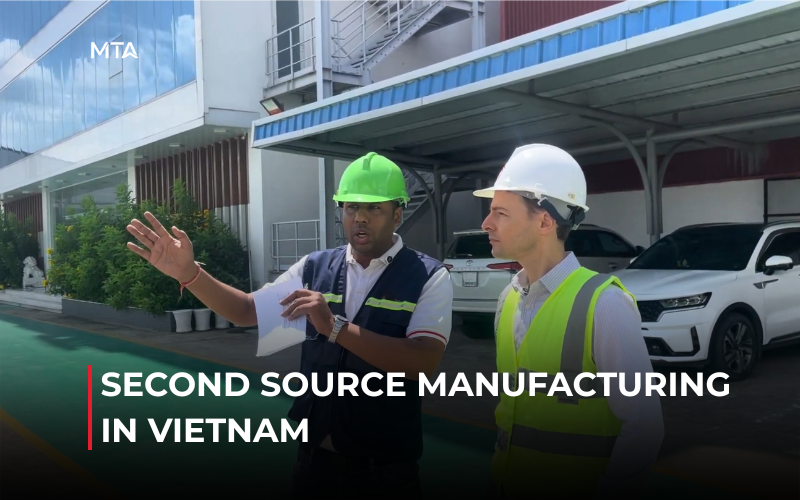
For companies that rely heavily on one manufacturing partner, developing a second source can provide greater flexibility and reduce dependence on a single factory. It can help businesses manage capacity constraints, respond to changing demand, and build more options into their supply chains without necessarily replacing an established supplier.
Vietnam is one option for companies looking to diversify manufacturing in Asia. Its existing manufacturing base and supplier networks offer opportunities across a range of product categories and production processes.
However, adding a second source involves more than finding another factory that can make the same product. The new supplier must meet the company’s technical, quality, cost, and delivery requirements, and its capabilities need to be verified before production volumes are increased.
The challenge is to identify the right manufacturer, validate its performance, and build a second source that works alongside the existing supply chain.
Why Add a Second Manufacturing Source in Vietnam?
A company may have a long-standing relationship with its current supplier and still decide to develop another production source. The objective is not necessarily to replace the existing manufacturer. In many cases, it is about creating another option within the supply chain.
The main reason is supplier dependency. When most or all production is concentrated with one manufacturer, problems at that factory can have a direct impact on the buyer’s operations. Capacity constraints, production delays, quality issues, material shortages, or unexpected changes in demand can become more difficult to manage when there is no alternative source.
A second manufacturing partner provides another production option. Depending on the company’s strategy, this additional supplier may be used for backup capacity, selected product lines, peak demand, or regular production.
It can also provide greater flexibility as the business grows. If the existing supplier is approaching its production limits, an additional manufacturer can help absorb new orders rather than requiring the original factory to handle all incremental demand.
There is also a commercial benefit to having more than one qualified source. Companies can compare suppliers on areas such as pricing, quality, lead time, production efficiency, and responsiveness. These comparisons can provide useful information when making future sourcing decisions.
For these reasons, second sourcing should be viewed as more than simply finding a cheaper supplier. The broader objective is to create a supply base that gives the company greater flexibility while reducing excessive reliance on a single production partner.
How to Find and Qualify a Second Manufacturing Partner
Once a company decides to develop a second source in Vietnam, the first step is to establish what the new supplier actually needs to deliver.
This starts with a clear supplier profile. Before contacting manufacturers, buyers should define the relevant product specifications, expected production volumes, quality standards, target cost range, required certifications, packaging requirements, and delivery expectations. The more clearly these requirements are defined, the easier it becomes to distinguish between manufacturers that are genuinely suitable and those that simply appear relevant based on their product category.
Supplier identification can then begin through industry networks, trade fairs, sourcing platforms, referrals, or local sourcing partners. At this stage, the goal is not to select a supplier immediately. It is to build a shortlist of manufacturers whose capabilities appear to match the initial requirements.
The qualification process should then look beyond a supplier’s product catalogue or company profile.
Key areas to assess include:
- Production capacity: Whether the factory has sufficient capacity for current requirements and potential increases in volume.
- Technical capabilities: Whether its machinery, production processes, engineering resources, and expertise are appropriate for the product.
- Quality management: How quality is controlled throughout production and whether inspection procedures are clearly defined.
- Commercial fit: Whether pricing, MOQ, tooling, packaging, and other costs are compatible with the buyer’s requirements.
- Lead times: Whether the manufacturer can meet expected production and delivery schedules.
- Compliance: Whether the supplier can meet relevant regulatory, certification, environmental, or customer-specific requirements.
Capacity deserves particular attention. A factory may produce the right type of product but still be unsuitable if its current workload leaves little room for additional orders. Similarly, a supplier may have impressive equipment but limited experience with the specific specifications or quality standards required by the buyer.
Communication is another practical consideration. A second source is expected to become part of an ongoing supply relationship, so responsiveness and the ability to understand technical requirements can matter just as much as the initial quotation.
At the end of this stage, the company should have a smaller group of suppliers that are worth validating further. The purpose of qualification is therefore to answer one question: Does this manufacturer have the potential to become a suitable second production source?

How to Validate Before Scaling Production
A supplier can look suitable during the initial screening process and still perform differently once actual production begins. This is why supplier qualification should be followed by practical validation.
For overseas buyers, a factory visit can be particularly useful. A visit allows the buyer to see how the facility operates rather than relying entirely on information provided remotely. Depending on the product and sourcing requirements, the assessment may cover production lines, equipment, material handling, quality control points, warehouse management, workforce organization, and production planning.
The discussions held during a factory visit can also reveal information that may not be obvious from a company presentation. Buyers can ask how the factory handles quality issues, manages peak production periods, works with subcontractors, controls incoming materials, or responds when production falls behind schedule.
However, an on-site assessment should not be considered the final step. The supplier still needs to demonstrate its ability to produce the required product consistently.
For many businesses, this means moving through a controlled validation process. Samples can be reviewed against the required specifications first. If the results are acceptable, a pilot order or limited production run can provide a more realistic test of the supplier’s capabilities.
During this stage, companies can monitor factors such as product quality, consistency between units or batches, production lead time, communication, packaging, documentation, and the supplier’s response to problems.
The results can then be compared with the requirements already established and, where appropriate, with the performance of the existing supplier.
This comparison does not necessarily mean that both manufacturers must operate in exactly the same way. Different factories may use different equipment or production processes while still achieving the required outcome. What matters is whether the new supplier can consistently meet the agreed specifications and commercial expectations.
A gradual approach is generally more practical than immediately transferring a large share of production. If the supplier performs well during the initial orders, the buyer can progressively increase volumes and responsibilities.
In other words, validation should answer a different question from initial qualification:
Qualification asks whether a supplier looks capable. Validation tests whether it can actually deliver.
That distinction is important when developing a second source. A supplier should not become a major part of the supply chain simply because its profile, quotation, or sample looks promising.
Key Considerations When Building a Second Source
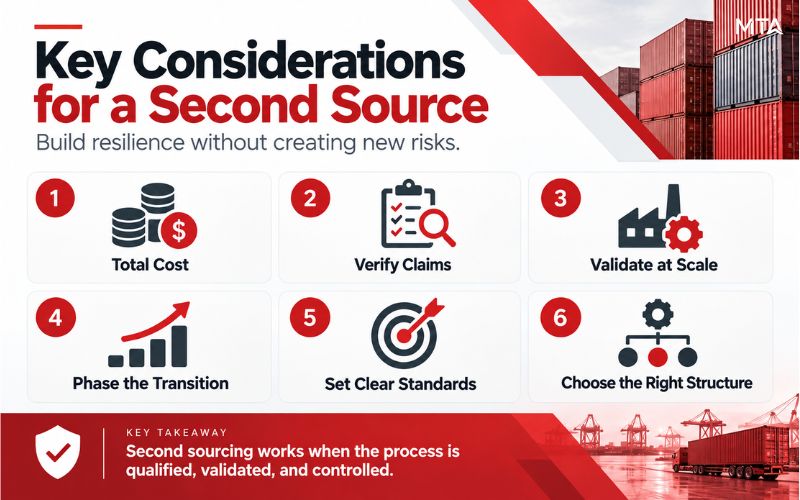
Developing a second supplier can strengthen a company’s supply chain, but only if the process itself is managed carefully. Otherwise, a new supplier can introduce additional quality, cost, or delivery problems rather than reducing existing risks.
One common mistake is choosing a manufacturer primarily because its quotation is lower. Unit price is an important sourcing factor, but it does not provide a complete picture of the cost. Higher defect rates, additional quality inspections, longer lead times, higher MOQs, tooling expenses, packaging differences, or unexpected logistics costs can change the overall economics of an order.
Another issue is relying too heavily on supplier-provided information. Company profiles, production figures, certifications, and references are useful for initial screening, but they should be considered part of the qualification process rather than conclusive proof of capability. Where appropriate, these claims should be checked through documentation, factory assessments, references, samples, or production trials.
Skipping production validation can create another problem. A sample may meet the required standard while the full production run reveals inconsistencies. This can happen because production conditions, materials, operators, equipment settings, or quality controls differ when the factory moves from a small sample to a larger order.
The transition should therefore be managed in stages. Rather than immediately assigning substantial volumes to a new supplier, companies can begin with a controlled order and establish clear performance expectations. This gives both sides an opportunity to identify and resolve issues before the relationship becomes more significant.
It is also important to define what success looks like before production starts. Quality requirements, acceptable tolerances, delivery expectations, documentation, inspection procedures, and communication channels should be clear to both parties. Clear expectations reduce the risk of disagreements once production is underway.
Finally, developing a second source does not necessarily mean maintaining two identical suppliers for every product. A company may decide to use different manufacturers for different product categories, regions, production volumes, or stages of the supply chain. The right structure depends on the company’s products and operational requirements.
Conclusion
Developing a second manufacturing source in Vietnam can help companies build a more flexible supply chain without immediately replacing an established supplier. The value, however, depends on finding a manufacturer that meets the project’s requirements and proving its ability to deliver consistently.
From supplier identification and qualification to factory assessment, production validation, and gradual volume ramp-up, a structured process helps companies make this transition with greater confidence.
For companies exploring Vietnam, working with a local partner can support supplier identification, on-the-ground verification, and coordination with manufacturers throughout the process.
MoveToAsia helps international companies identify and develop manufacturing partners in Vietnam, from initial supplier search to factory assessment and production support.