


It’s apparent why companies have strategically chosen the Philippines to build offshore teams. They handpick employees from a skilled labor pool offering proficient English and are willing to work for less. Decades of developing the Business Process Outsourcing (BPO) industry and building Shared Services and Multinational (MN) Operations have produced a workforce that has become accustomed to dealing with foreign managers, remote working, and flexible service standards. The case for team building in the Philippines at more professional and technical levels also goes beyond the daily minimum wage of ₱695 in Metro Manila. It’s about the combination of cost per output, talent, and communication, as well as the high service standards expected from offshore operations that make the Philippines one of the most cost-effective options in Asia for building customer service, BPO, finance, or technology functions.
Labor Market and Wage Levels
As of 2026, the regional daily wage in the Philippines varies between ₱366 and ₱695 across the country, with Metro Manila at the top and several provincial regions between ₱400 and ₱500. Foreign investors building large teams in the Philippines, for example a 200-seat customer support operation, have become accustomed to considering substantial variances within the cost of labor, service, and infrastructure when selecting locations within the country, for example between Davao or Iloilo and Makati.
The local tech sector and startups have created domestic demand alongside offshore demand for remote hiring in the Philippines. As a result, the marketplace for software developers, finance analysts, digital markers, and data specialists has become highly competitive. There are lucrative salaries for mid-level positions and above in Metro Manila. Skilled software engineers and employees with Cloud and AI skills who are in competitive offshore teams are earning over 100K. Cyber finance professionals with a CPA and 4-6 work experiences have salaries of 45-75K, above customer service and operations professionals with the same experiences (30-50K). Cebu and Davao offer 15-25% lower salaries and have significant cost-saving opportunities for operations and access to talent.
Statutory Obligations and True Employer Cost

An accurate hiring budget must understand what Philippine laws add on to gross salary. Three social benefit programs create mandatory employer contributions. These are: the Social Security System (approx. 9.5% of monthly stipend); PhilHealth (2.5% of salary); and Pag-IBIG (2% of monthly salary up to the ceiling). The 13th-month pay must be considered as well. This pay is an annual legal requirement in the Philippines which is the equivalent to one-twelfth of the total annual basic salary of the employee and basically an additional 8.33% to annual payroll. This must be paid every December 24 to all rank-and-file employees with one-month tenure in the covered year.
Based on the four components above, employer guides indicate that annual employer expenses in the Philippines is approximately 120% to 125% of gross salary. For a practical budget example, an employee with a gross salary of ₱40,000 per month will cost the employer ₱48,000 to ₱50,000 per month due to mandatory benefits (SSS, PhilHealth, Pag-IBIG, and the 13th- month benefit) and excludes other voluntary benefits. That 20% to 25% add-on does not account health insurance beyond PhilHealth, meal allowances, transport expenses, and performance bonuses which are common in the Metro Manila labor market and adds 5% to 15% on top of the statutory floor.
Employees’ hours are regulated by the Philippine Labor Code, establishing an 8 hour work day and 48 hour work week. Employees that exceed the standard work day are entitled to overtime pay at 125% the standard hourly wage for work on regular days. Overtime pay increases to 130% for work on rest days and to 200% for work on regular holidays. Employees that work the night shift are entitled to a 10% night shift premium for work between the hours of 10 PM and 6 AM. This is especially important in planning payroll for employees that work in customer service and BPO that work on a different time zone to the Philippines.
The Labor Code provides employees with 5 service incentive leave days after 1 year of service. Employees are also entitled to leave for other specific instances such as 105 days of maternity leave and 10 days of paternity leave. Employers offer leave packages in excess of the statutory minimum to retain employees in an environment where employees are constantly switching jobs.
Hiring Models
Direct employment is the most common model used by foreign investors that have established a business in the Philippines and wish to have an operational presence in the country. This is when the employees of the Philippine company are employed in accordance with Philippine employment laws.
Contractor arrangements are common in the Philippines for project-based or specialized roles. However, Philippine labor law has a unique concept called “labor-only contracting.” Courts and the Department of Labor and Employment consider this “labor-only contracting,” and contracting companies will owe employees the same statutory benefits regardless of the label given in the contract. Companies that use independent contractors, but the contractors perform tasks that are functionally equivalent to employment (e.g., the independent contractors work set hours, are supervised by the contracting company, and use tools and work spaces provided by the contracting company) are likely to face the same issues and liability for registered and unremitted SSS, PhilHealth, Pag-IBIG contributions and employee benefits.
Employer of Record (EOR) contracts offer a popular alternate option with foreign clients who are building their teams in the Philippines and wish to avoid the regulatory and administrative burdens of operating their own registered entity. EOR companies are licensed to engage and employ staff, and sign employment contracts with staff on behalf of client companies. EOR companies handle all employment law, payroll, compliance, and statutory contributions, and in exchange for a significant mark up (10% to 20% gross pay) EOR clients avoid management of compliance. For companies that are piloting business in the Philippines, and/or to establish a first team of 5 to 20 employees, EORs represent a viable market entry option compared to the full registration and compliance of a wholly owned subsidiary.
The best model for outsourcing in the Philippines is the BPO model. This works best when the function to be outsourced has clear deliverables, defined service levels, and a concrete framework for the service delivery. Some examples include customer support, finance and accounting BPO, and some IT managed services.
Where to Build Your Team
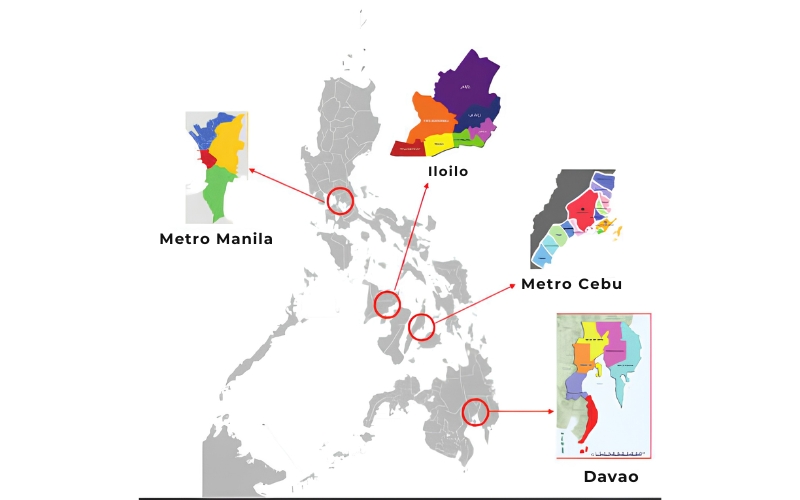
The deepest and most diverse talent pool in the Philippines is in Metro Manila, especially in the sub-markets of Makati, BGC, Ortigas, and Quezon City. This includes the highest concentration of talent and skills in finance, technology, management consulting, and other specialized professions. The tradeoff includes the highest wage costs, the most competitive talent market, and the cost of office infrastructure.
Cebu City is the main secondary BPO hub in the Philippines, and has significant pools of English-speaking customer service, technical support, and IT shared services talent, as well as an adequate university system and relevant workforce at competitive wage levels compared to Metro Manila. Davao in Mindanao has been developing as a BPO and operations hub within a government-friendly business environment and developing digital services. Iloilo in the Visayas is an emerging hub for early-stage offshore teams with a strong university base and attractive cost levels.
Retention, Culture, and Remote Team Design
If you treat the Philippine workforce well, they will keep coming back. Loyalty is the main trait of this workforce, but it’s going away because of BPO and shared service businesses poaching talent. These loss-leading strategies (clear progression, enhanced leave, real learning and development, new recognition) offer financial payback during the time it takes to replace the employee (three to four months of salary). Remote and hybrid work is the new normal, especially during and after the pandemic (2020-2022). Employers that stick to five-day office work will have a harder time attracting top talent.
Frequently Asked Questions
How much does it cost to hire in the Philippines? After SSS (approximately 9.5% employer share), PhilHealth (2.5%), Pag-IBIG (2%), and mandatory 13th month pay (8.33% annual base), total employer cost is 120% to 125% of gross base salary.
Is the Philippines a good location for customer support teams? Always yes! High English skills, strong service culture, easy BPO and support channel integration with the US and Australia, great time zone overlaps, and relatively low staff costs, make the Philippines one of the best places for offshore customer support.
What statutory benefits do Filipino employees have? First, these employees are eligible to receive benefits from the Social Security System, PhilHealth, and Pag-IBIG services, along with the payment of the 13th-month pay, 5 service incentive leave days, and other expanded statutory leave benefits. The expanded statutory leave benefits include maternity, paternity, and other leaves as provided by special laws, as well as leaves related to certain health and safety issues.
In the Philippines, should a foreign investor use an Employer of Record or direct employment? The Employer of Record model is more efficient and incurs a lower compliance cost for managing small teams, 5 to 20 employees, at a cost premium of 10% to 20% of the employees’ gross salary. In other cases, such as large teams and long-term company operations, direct employment through a license is more cost effective.