


Laos offers a selective mining investment case rather than a broad resource boom. The country has commercially relevant deposits, established foreign participation and direct access to large neighbouring markets. In 2024, mining and quarrying represented 2.8% of gross domestic product (GDP). Laos was also the world’s sixth-ranked potash producer, with 5.1% of global output, and the fourth-ranked producer of refined bismuth, with 3.0%. Copper, gold, gypsum, barite, tin, iron ore, lead, silver and construction minerals add breadth to the resource base.
The macroeconomic context strengthens the importance of exports but raises the hurdle for project finance. Real GDP grew by 4.8% in 2025, exports increased to 73% of GDP and foreign direct investment remained near 8% of GDP, concentrated mainly in electricity, mining and agriculture. External debt service, foreign-exchange management, imported-fuel exposure and limited fiscal buffers remain material constraints.
For foreign investors, the decisive question is not whether Laos has minerals. It is whether a specific deposit can be licensed, financed, supplied, transported, processed and closed responsibly. The strongest opportunities combine verified geology with an identified customer, infrastructure access, clear concession rights and environmental and social controls that meet both Lao requirements and international lender expectations.
Mining in Laos: the investment case at a glance
Laos’s mining proposition rests on mineral diversity, proximity to China, Thailand and Vietnam, improving rail connectivity, and a legal framework that permits international participation through concession structures. These advantages are meaningful, but none removes the need for project-level validation.
Table 1. Laos mining investment landscape
| Dimension | Latest evidence | Investor implication |
| Sector position | Mining and quarrying contributed 2.8% of GDP in 2024. Laos ranked sixth globally in potash and fourth in refined bismuth output. | The sector is relevant, but scale is concentrated in a limited number of commodities and assets. |
| Export platform | Exports reached 73% of GDP in 2025; mining was among the drivers. FDI was about 8% of GDP and remained concentrated in resource sectors. | Export-oriented projects fit the national growth model, but foreign-exchange, tax and repatriation procedures require validation. |
| Regional access | The Laos-China Railway has improved connectivity, and the government has promoted potash development following its opening. | Rail can improve competitiveness, but mine-to-terminal haulage, loading capacity and border procedures remain project-specific. |
| Legal structure | Mining is a concession business under the amended Investment Promotion Law, while the amended Minerals Law governs the mining cycle. | Rights depend on staged approvals, a concession agreement, sector licences and continuing compliance. |
| Core constraint | Debt vulnerabilities, fuel exposure, skills shortages and environmental and social obligations can change project economics. | Models need downside cases, closure funding and contingency allowances from the beginning. |
Sources: IMF (2026); Lao People’s Democratic Republic (2017, 2024); USGS (2026a); World Bank (2026).
Why Laos matters in regional mining
A diversified resource base with proven production
Laos is already a producer, not only an exploration concept. Most mineral commodities are produced by private international companies, demonstrating that foreign operators can participate when concession, technical and financing conditions are acceptable.
National rankings still require interpretation. The country’s bismuth position reflects real processing capability, but its sole refinery was idle by the end of 2024. Investors should therefore assess operating status, reserve life, recovery rates and logistics rather than treating national output as proof of project bankability.
Regional access and value-add policy
Laos’s location between major Asian markets supports several routes for fertiliser minerals, metals and industrial inputs. The Laos-China Railway strengthens access to southwestern China and has supported government promotion of potash; exploration, mining and processing rights have been granted to 18 companies. However, mountainous terrain, mine roads, transloading, wet-season disruption and border procedures can still dominate delivered cost.
The Minerals Law states that processing should primarily occur in Laos to add value. The government has also introduced export duties on primary mining exports. This strengthens the rationale for beneficiation, fertiliser production, recovery optimisation and shared processing infrastructure, provided feedstock, energy, water and tax economics are competitive.
Most credible mining opportunities in Laos
Potash and fertiliser minerals
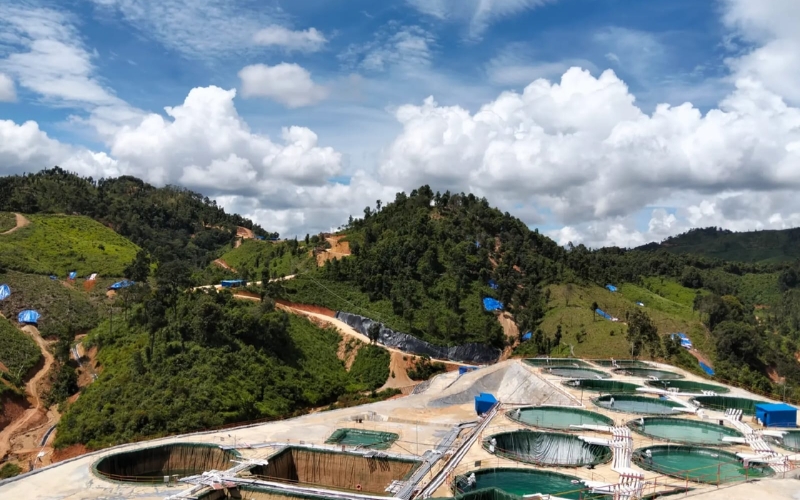
Potash is the clearest scale opportunity. Laos accounted for 5.1% of estimated global output in 2024, and potash is a primary potassium source for agricultural fertiliser. Proximity to Asian agricultural markets and rail access to China support the demand thesis.
The opportunity extends beyond mine ownership to drilling, brine management, processing equipment, material handling, storage, laboratories and rail logistics. Critical diligence includes deposit chemistry, recovery, water balance, subsidence, waste-salt management, energy use, rail capacity and offtaker credit.
Copper and gold brownfields
Laos has an established history of copper and gold production. More defensible opportunities may sit in brownfield extensions, resource conversion, recovery improvement and exploration around known districts rather than in large speculative greenfield projects.
Existing infrastructure can reduce development time, but legacy liabilities can offset the advantage. Investors should independently review resource models, metallurgy, tailings stability, closure provisions, community commitments, historic taxes and transferability of rights.
Industrial minerals and construction inputs
Gypsum, barite, limestone, clay, stone, sand and gravel can support domestic construction, cement production and regional industry. These projects may require simpler processing and shorter development cycles than metal mines.
Their economics are highly location-sensitive. The preferred model is usually anchored by a cement plant, construction programme, industrial customer or export distributor. Product specification, quarry life, road impacts and rehabilitation costs must be tested against delivered prices.
Processing, technology and mining services
Policy support for domestic value addition creates openings in concentration, fertiliser production, tailings retreatment, ore sorting, water recycling, plant automation and predictive maintenance. A processing or equipment investor can contract with several mines or use tolling and performance-based models, reducing direct geological risk.
The regulatory framework also creates demand for drilling, assay laboratories, geotechnical work, hydrogeology, environmental monitoring, tailings management, safety, digital reporting and closure engineering. This route can be more accessible for foreign SMEs, provided named clients, local technicians, spare parts and procurement channels are secured.
Table 2. Priority opportunities and preferred entry routes
| Opportunity | Why it is credible | Preferred entry model | Critical diligence question |
| Potash and fertiliser minerals | Established global position, government promotion and access to Asian demand | Concession or joint venture; equipment, processing or logistics contract | Can the deposit, water system and transport chain deliver competitive product throughout the project life? |
| Copper and gold brownfields | Production history and potential for mine-life or recovery improvement | Acquisition, minority investment, technical partnership or earn-in | Are reserves, metallurgy, title, taxes and legacy liabilities independently verified? |
| Industrial minerals | Recurring construction and industrial demand with simpler processing | Quarry-processing operation with anchor customer or offtake | Is delivered cost competitive after road, border and rehabilitation costs? |
| Beneficiation and recovery | Policy preference for in-country value addition and duties on primary exports | Toll processing, plant joint venture, equipment lease or performance contract | Is feedstock secure and is the energy-water-tax configuration bankable? |
| Mining services and ESG systems | Operators need technical capability across the mine lifecycle | Local subsidiary, distributor, service alliance or project contract | Is contracted demand sufficient to support local staff, equipment and after-sales service? |
Regulatory framework for foreign mining investment

Mining as a concession business
The 2024 amended Law on Investment Promotion classifies mining as a concession business. Investors must be legal entities and demonstrate experience, operating history and financial capacity. Projects with complete state information may be tendered, while competing proposals for the same area can trigger competitive selection. A One-stop Investment Service Office coordinates investment processes, but mining remains subject to the Minerals Law and other sector rules.
The investment law caps a concession-business term at 50 years, subject to project conditions and other laws. The Minerals Law separately provides that a mining licence may run for up to 20 years and can be extended in increments of up to 10 years. Investors should reconcile the concession agreement, mining licence, land rights and closure period rather than rely on one headline term.
A stage-gated development process
A foreign mining project should expect the following sequence:
1. Establish the investment vehicle and confirm area availability or tender conditions.
2. Obtain prospecting and exploration rights with an approved work programme.
3. Submit geological data and secure official acceptance of the resource and reserve basis.
4. Prepare a feasibility study covering mine design, processing, market, infrastructure, costs, workforce, risk, waste, tailings and closure.
5. Complete environmental and social studies, compensation planning and management plans, and obtain the environmental certificate.
6. Execute the Mining Development Agreement or concession agreement, provide securities and obtain construction approvals.
7. Secure the mining licence and operating approvals, then maintain tax, safety, environmental, community and reporting compliance.
8. Fund and implement rehabilitation and closure from the start, including post-closure monitoring.
For large projects, the ministry may recommend independent review by a reputable mining specialist. This should be budgeted early because it also supports lender confidence.
Capital, incentives and transfer
The 2024 law introduced tiered registered-capital requirements. Projects below USD 50 million require at least 30% of total investment as registered capital. Larger projects have lower percentage ratios but minimum thresholds: USD 15 million for projects from USD 50 million to USD 100 million, USD 20 million from USD 100 million to USD 500 million, and USD 25 million above USD 500 million. Capital importation follows statutory timing and requires Bank of the Lao PDR certification.
Mining extraction is not expressly included in the nine sector-based incentive categories in Article 9. Related activities—such as environmentally friendly processing, natural fertiliser production, resource-efficient technology, infrastructure or logistics—may qualify, subject to regulations and project approval. Incentives should therefore be modelled as conditional.
Transfers of rights, changes in shareholders and material project changes require approval. A buyer must verify that taxes, fees and contractual obligations are satisfied, making legal, fiscal and environmental due diligence essential before an acquisition or joint venture.
Environmental, community and closure obligations

The Minerals Law requires feasibility work to cover affected communities, land compensation, environmental and social management, rehabilitation, closure and post-closure monitoring. Closure planning begins with operations, is reviewed periodically and must be backed by financial security through an approved Lao banking mechanism. Projects also contribute to designated environmental, community, human-resource, project-management and sustainable-mining funds.
Lao compliance should be treated as the minimum baseline. The IFC mining guidelines provide recognised technical benchmarks, while the OECD minerals guidance sets out a five-step framework for management systems, risk identification, mitigation, independent audit and public reporting.
Principal risks investors should price
Geology, title and legacy liabilities
Investors should confirm licence boundaries, overlapping claims, reserve classification, sampling quality, metallurgy and official acceptance of the resource estimate. Brownfield acquisitions also require review of tailings, closure funding, historic taxes, land arrangements and undocumented community commitments.
Commodity, financing and foreign exchange
Projects should be tested at conservative price decks with sensitivity to grade, recovery, fuel, reagents, freight, royalties, export duties and construction overruns. Laos’s debt and foreign-exchange vulnerabilities can affect banking, cash conversion and lender requirements, even where the project earns export revenue.
Infrastructure and imported inputs
Mines depend on diesel, explosives, tyres, reagents and specialised equipment moving through long supply chains. The 2026 fuel shock showed how quickly costs can rise. Alternative corridors, wet-season inventory, critical spares, power redundancy and practical rail capacity should be included in feasibility work.
Environmental and social licence
Water use, tailings, acid drainage, dust, road safety, land acquisition and impacts on ethnic communities can delay a project despite formal permits. Early engagement, transparent compensation, local hiring, grievance mechanisms and independent monitoring are commercial risk controls.
Workforce and counterparties
Laos faces skills constraints and labour migration. Projects need realistic localisation, training and contractor-development plans while preserving access to specialist expertise. Partners, contractors, intermediaries and offtakers should also be screened for beneficial ownership, conflicts, anti-bribery exposure and environmental or human-rights history.
Recommended market-entry models
A direct greenfield concession offers control but carries the longest timeline, highest exploration risk and greatest infrastructure and stakeholder exposure. It suits investors with patient capital and a deposit capable of supporting dedicated development.
A joint venture, earn-in or brownfield acquisition can shorten the route to production but increases legacy-risk exposure. Completion should be conditional on government approvals, title confirmation, independent technical review and an agreed remediation plan.
A service, technology or processing entry often offers the best risk-adjusted starting point for an SME or first-time Laos investor. It builds operating evidence without immediate reserve risk. Contracts should define payment currency, import responsibility, performance testing, spare parts, site access and termination.
A staged approach is generally preferable to one large commitment. A representative office may support market study and project follow-up but cannot conduct commercial operations. Investors can then establish an operating entity, secure anchor contracts, pilot the service or process, and expand after payment, logistics and regulatory assumptions are proven.
From mining interest to an investable project
Before committing capital, an investor should complete eight tests:
1. Confirm the customer, product specification, volume, price mechanism and delivery point.
2. Reconcile the concession, mineral licence, coordinates, land rights and transfer conditions.
3. Commission independent resource, metallurgy, mine-plan and recovery reviews.
4. Map power, water, fuel, roads, rail, border handling, taxes, duties, working capital and closure security.
5. Establish environmental and social baselines, including affected communities and cumulative impacts.
6. Validate capital importation, banking, export proceeds, debt service and dividend processes.
7. Screen beneficial ownership, technical capability, litigation and compliance history of critical counterparties.
8. Link each capital tranche to permits, resource confidence, offtake, infrastructure and community milestones.
Mining in Laos can be attractive when approached as a project-specific industrial investment rather than a simple bet on mineral demand. Potash has the clearest scale and regional-market logic. Copper and gold can offer brownfield improvement opportunities, while industrial minerals, processing and specialised services may provide more accessible routes for SMEs.
The risks are equally clear. Concession terms, resource quality, fuel and logistics costs, foreign exchange, tax treatment, community acceptance and closure obligations can materially change returns. Investors that verify these factors early, use independent technical and legal review, and commit capital in stages will be better positioned than those relying on national production rankings or commodity-price optimism.
How MTA supports mining market entry in Laos
MTA supports international companies in converting sector interest into a practical Laos market-entry decision. Assignments can include:
- Mineral, customer, competitor and project screening.
- Partner, supplier and beneficial-ownership validation.
- Site, infrastructure, border-corridor and logistics assessment.
- Regulatory pathway mapping and coordination with specialist legal and technical advisers.
- Offtake interviews, risk-register development and a staged implementation plan.
For a concession, acquisition, processing project or technical-service launch, the objective is the same: identify where the opportunity is commercially defensible, legally executable, operationally resilient and compatible with responsible-investment standards. Companies considering the Laos mining market should complete this validation before negotiating irreversible commitments or basing a regional strategy on headline resource potential.