


This guide will help the user understand the Cambodian labor market, the cost of recruitment, various hiring concepts, and ways to build a team that will help the business grow.olve the most. And if it turns out that what you like is in Cambodia, don’t hesitate.
Cambodia’s Labor Market in 2026
The young and growing population of Cambodia, and its ongoing development, has resulted in a larger workforce that is expeditious and relatively inexpensive compared to competitors within the ASEAN. In the last two decades, the developing workforce of Cambodia has become a key competitive advantage.
Reports from the World Bank, the International Labour Organization (ILO), and Cambodia’s Ministry of Labour and Vocational Training (MLVT) indicate that Cambodia’s population is relatively young and that its labor market is even more so. Compared to many developed Asian economies, the relatively young population helps businesses by providing access to a larger working population each year.
Employment growth is strongest in the fields of manufacturing, logistics, construction, tourism, retail, financial services, and professional services. Manufacturing (garments, footwear, travel goods, and electronics) remains a primary employer of the laborers. Additionally, the growth of the fields of banking and technology, and business services, are employing more skilled labor.
The availability of labor varies greatly depending on the role in question. Entry-level and clerical positions are typically not very competitive, especially in larger cities such as Phnom Penh. Many graduates enter the workforce each year as business administration graduates, as well as graduates of accounting, finance, and marketing. Conversely, roles such as engineering and IT, and accounting, as well as positions in management, become harder to fill. Reports of foreign businesses indicate a greater degree of difficulty filling positions that demand technical knowledge and good command of English.
The scarcity of skilled talent is more acute at the senior management level. There is a shortage of business leaders who can manage large teams, implement global standards, manage complex operations, and fill management roles.
Foreign investors continue to hire locally because Cambodian employees are very adaptable, understand the local market, and are more affordable. Many businesses are able to build strong and fully functional teams while keeping operating costs lower than other neighboring markets, by investing in training and developing leadership skills for their employees.
For businesses entering the Cambodian market, the skills of the local labor force and the gaps in those skills must be understood. Many of the successful businesses in Cambodia have locally employed staff, but also use skills and workforce development training initiatives to build and strengthen the skills of the employees to achieve sustainable growth and fill the gaps they may have.
Recruitment Costs, Salaries and Employment Obligations

Foreign companies in Cambodia need to go beyond looking at base salary offerings when evaluating costs for hiring employees. Costs associated with hiring employees include mandatory contributions, costs to recruit employees, employee benefits, and costs to develop employees.
Compensation levels may be different due to industry, location, size of the company and the level of experience of the candidates. Generally, compensation in Phnom Penh is the highest due to the presence of MNCs, banks, NGOs and professional service companies.
While general compensation statistics are helpful and provide some guidance, real compensation is different and is highly industry focused and based on the level of international engagement.
Employers are required to meet a number of employee and labor laws in Cambodia. One of the bigger employee laws is joining the National Social Security Fund. This fund offers health care and safety net employment for employees. Employers are also required to meet Cambodian labor employee laws on annual leave, public holidays, overtime, and severance.
When evaluating the cost to employ people, the cost to recruit employees may be significant. This includes the cost of advertising jobs, screening candidates and interviewing employees, in addition to the cost of onboarding. For management and employees with a special skill set, many foreign companies use recruiting firms. Agency fees are typically between 15% and 25% of the annual gross salary of professional employees.
The real costs associated with employing people are often not considered in a budget. Employee replacement, especially in technical and management roles, is costly due to the significant investment incurred to onboard and train employees, and the productivity loss employees experience during the time staff are being replaced.
Benefits have grown more critical to job seekers. To them salary is one consideration of many. Applicants analyze jobs considering health coverage, PD programs, incentive pay, flexible scheduling, and upward mobility.
International backers grasping the total cost of hiring will likely make prudent financial plans and not run the risk of underestimating workforce expenses while growing.ch, despite its progress, is still one of the countries where poverty is growing.
Hiring Strategies for Foreign Investors and SMEs

An effective recruitment strategy is more holistic than advertising job opportunities and sifting through applications. Foreign firms in Cambodia often see an advantage when they integrate recruitment into business and organizational integration when they plan recruitment.
One of the early challenges in recruitment is deciding what roles will be filled with the local workforce and what roles will be filled with expatriates.
Generally, administrative, finance, HR, Customer Service, Sales, and various operational roles can be localized. Cambodian staff are able to assist foreign firms with business and cultural practices.
Local staff are supplemented with expatriates for specialized technical roles and management roles where expatriates are required due to non-availability of that expertise in Cambodia. Many firms are also looking at localizing management roles and expatriates will be used in these roles.
There are a number of recruitment methods that can be used in Cambodia. A number of online methods can be used including LinkedIn, BongThom, and CamHR. Other methods include recruitment by visiting some of the universities and vocational training centers.
For expedited recruitment, employment agencies are used, and this is especially true for recruitment of finance managers and specialists, engineers, and other operational roles, including country managers.
Foreign investors also have alternatives to traditional hiring. Depending on their needs, businesses may consider:
- Direct employment
- Staffing agencies
- Outsourcing arrangements
- Employer of Record (EOR) services
EOR solutions allow firms to have a presence in the Cambodian market and hire staff without the administrative burden of establishing a legal business. This is an alternative that more firms are looking at for recruitment.
Foreign employers often make the error of emphasizing salary alone while attracting competing talent. In actuality, factors of workplace culture and company culture, as well as management and employees’ upward career mobility, are the factors that draw the most valid talent.
Another misallocation of resources tends to be the abuse of training and onboarding resources. Employees who are given a clear structure for onboarding and training spend their time doing more productive work and are less likely to leave.
Especially for smaller businesses, gaining valid talent often depends on establishing a positive reputation for being a good employer early on and fostering a culture that employees can envision themselves being a part of for the long term.
Building and Retaining a High-Performing Team
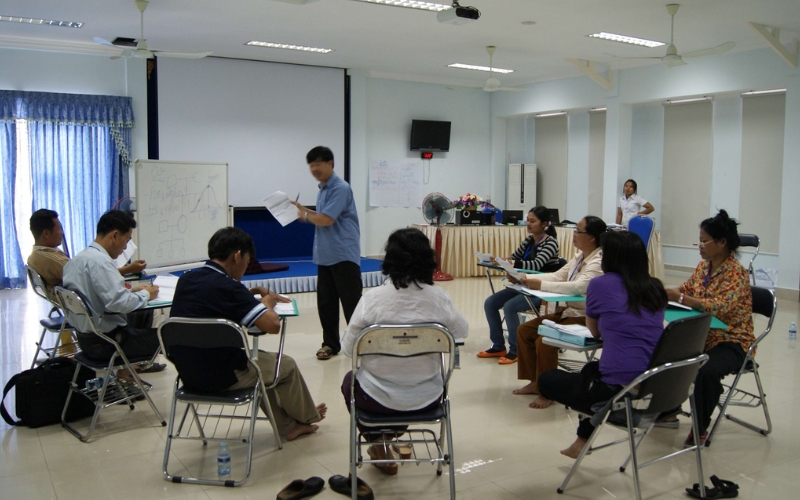
Finding good talent is only the first step. It gets trickier to retain them as Cambodia’s labor market gets more competitive.
Employee turnover is more of a problem for some businesses than others, especially those that are fast growing. Since employees are the prize, competition is cutthroat, not just for multinationals, but for local companies and businesses in the region as well.
Developing employees is known to improve retention, especially with younger professionals, who put more of a premium on being able to learn, become responsible, and grow with the company. The presence of training, mentoring, and especially leadership development, makes employees more engaged with the mission of the company, with a positive effect on retention.
Because Cambodia suffers shortages of employees with management and professional skills, especially in technology and engineering, a workforce development strategy is useful. For companies to be competitive, they must invest more in developing employee skills, rather than only focusing on recruitment.
Retention and recruitment are less competitive with good salaries, but employees want a positive company culture, good leadership, and flexible work. These positive cultures are the most competitive in the labor market.
Culture and local practices are critical to foreign-owned businesses. In Cambodia, companies that are able to combine a local work culture with an internationally accepted management model get the best operational results.
Performance management is a crucial aspect of team building. Employees appreciate knowing how the objectives the organization sets for them contribute to their personal success as well as the success of the organization. Defining the process for how employees will gain feedback, what will be expected of them to advance, and how they will stay accountable to the organization aids with long term team building planning.
Investing in employee engagement and career and leadership development creates a competitive advantage that transcends pay. Not taking the opportunity to develop employees in a highly competitive business environment is an unfortunate loss that impacts the business negatively and impacts the opportunity costs of the investments the business has made.