


According to CBRE | WTW, the phrase, “moving from resilience to relevance,” describes the state of their market as they enter 2026, and it describes the state of Malaysia’s market as well. The post-pandemic recovery is broad and stabilizing but is shifting toward a selective cycle. The level of demand for real estate is increasingly affected by location, ease of access, and sustainability. The most influential factor of this phenomenon is the 13th Malaysia Plan. The 13th Malaysia Plan allocates 430 billion ringgit in development expenditure for the years 2026 to 2030. This establishes an ongoing, direct linkage between the public investment of infrastructure and the private investment of real estate throughout the country.
Malaisian Real Estate Market Overview
Each sector of Malaysia’s developed and developing real estate markets has unique investment demand and risk characteristics as we approach 2026. For example, demand for commercial office space is determined by the performance of Grade A, ESG, and transit-oriented buildings, while demand for older, non-sustainable, rail-disconnected buildings, particularly in Kuala Lumpur, is declining. In 2026, Knight Frank reported that Kuala Lumpur’s prime office spaces had gross rents of RM6.12 per sq ft per month. In 2026, Kuala Lumpur reported that office space had a 22.1% vacancy rate, with the city’s top buildings having the highest demand, and older, less desirable buildings facing increasing demand pressure. Industrial and logistics real estate is seeing positive demand as Malaysia continues to integrate into the global supply network, and as data centers and e-commerce fulfillment infrastructure expands. Demand for residential and mixed-use real estate is uneven. Projects that are located and priced well experience strong demand, while projects with unfavorable locations or that are overpriced remain unsold.
In a short period of time, the combination of sustainability and seamless transport integration have gone from being ‘nice to haves’ to being basic expectations in the market. Developers that up to 2021 viewed green building certifications as a premium offering now understand that green certifications are the minimum standard. Flight to Quality has become the standard, with the market’s best buildings absorbing the majority of demand, creating a greater need for the modernization and repurposing of sub-standard older buildings, rather than new builds.
A 2026 Market Snapshot of the Real Estate in Malaysia
Examining the expenditure figure of RM430 billion in the 13th Malaysia Plan is important, as it describes an investment thesis across diverse real estate segments. Spending in this way on infrastructure (roads, rail, public amenities, connectivity, and the morphing of urban spaces) creates immediate demand for construction along the project corridors and the acquisition of land that will benefit from the reduced travel time and the improved logistical intersection of industrial and residential spaces. The Rapid Transit System (RTS) Link from Johor Bahru to Singapore is one of the most surveilled singular projects, scheduled to be completed in 2026, with land prices along the Johor Bahru corridor already reflecting the expected increase in value due to improved accessibility. In 2026, some market segments may experience price increases that could be considered moderate (but are not expected to be more than 3%), while the less accessible and transit-linked market segments will experience increased price divergence that may be more extreme.
Higher-value properties in Kuala Lumpur and Johor, particularly, continue to attract foreign demand and the Malaysia My Second Home programme continues to bring a certain segment of long-stay foreigners to Malaysia. This demand is often located in the branded residences and integrated developments where the appeal of the security and managed services is that the owners may be absent for long periods of time.
Main Market and Sector Trends
The primary trend is growth spurred by increasing infrastructure. The ongoing investments into rail lines, specifically the MRT3 Mass Rapid Transit circle line, is reshaping the areas of the Klang Valley and Johor where value will me most keenly felt. Speculative premiums on land lots near MRT stations have been proven to be logical investments. The premium has remained strong through every phase of the MRT network.
The second most important aspect that will determine the winners and losers in Malaysian real estate is the efforts to comply with ESG metrics. The Budget of 2026 has provided incentives for adaptive reuse that will encourage the conversion of outdated, substandard commercial space, as opposed to the existing practice of new-build demolitions. This will impact several well-established commercial districts, in which the cost of renovating outdated structures to current building standards will exceed the rents. Developers of industrial parks are also integrating energy, wastewater, and green building systems as baseline, rather than optional, features. This is due to the increasing corporate demand for these features.
The permanent demand for innovative offices and mixed-use real estate that integrates work, retail, and hospitality will be evident in 2026’s markets. Some of Kuala Lumpur’s more successful office developments over the past three years have incorporated retail and hotel nodes in their design, as opposed to designs that allowed them to be standalone developments.
Investment Opportunities in Real Estate Developments
The most clear-cut investment theme in Malaysian real estate may be transit-centric developments. Here, demand is of little mystery and concern in developing real estate. This includes residential developments that are literally adjacent to MRT stations, mixed-use commercial developments that are integrated within the MRT station’s interchange, and retail and hospitality developments that are within the catchment area of the MRT.
The combination of industrial parks and logistics estates also provide firm opportunities for investment. Demand is being shaped by the global realignment of manufacturing bases and the construction of data centre and cloud infrastructure in the region. These estates provide the resources, including water and electricity, and the means of connecting with the world, i.e., fibre optics. Once developed, these estates draw tenants whose demand is unaffected, unlike the more cyclical demand that characterized the retail, residential and commercial sectors.
Integrated developments are somewhat of a commercial real estate equivalent to the lifestyle trend that has changed the way people and businesses think about their preferred location. The best developments in Johor and Kuala Lumpur show that when an entire precinct is controlled and combines residential, hotel, retail, and office uses, it will create a positive impact that is greater than any use achieved in isolation.
Risks and Challenges to know before investing
The biggest short-term risks will be an overhang in certain segments of the residential and commercial markets. The properties that had bad locational quality, pricing, and demand will deteriorate in today’s market where buyers and tenants care about quality and discounting won’t sell those properties. The cost of construction will continue to create challenges to get a positive spread in today’s market while margins become thinner due to the cost of modern labor, materials, and an increased level of green standards and energy efficiency. Changes to allow foreigners to buy residential properties will add to the uncertainty, but are not the biggest issues for Malaysian commercial properties that are residentially focused.
Resiential Real Estate in Malaysia in 2026
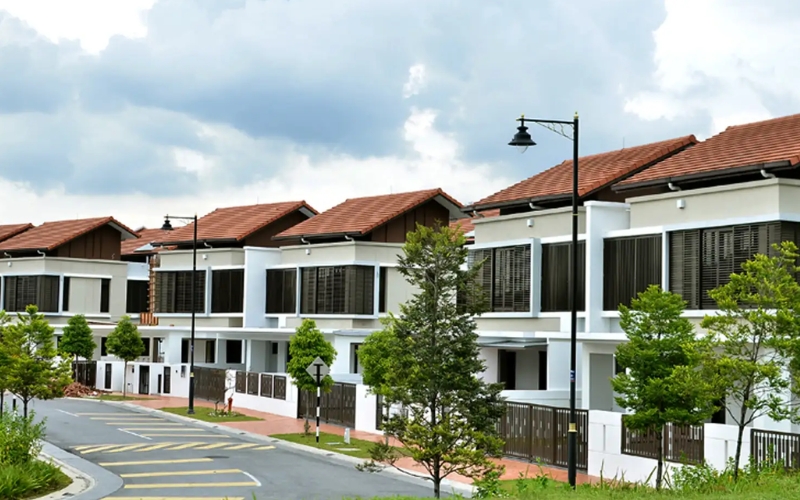
In Malaysia, several axes simultaneously divide the residential market. Resale transactions take place in the subsale market. In new launches, conducted by developers, different pricing dynamics come into play. As they are in secondary or oversupplied locations, developers’ launches tend to be less valuable than subsale properties. These, along with landed residential properties, which comprise linked houses, semi-detached houses, and bungalows that are located in established suburban areas and have historically appreciated more, have a separate residential market segment. The urban cores of the Klang Valley and Penang are along different trajectories than the suburban growth corridors and secondary cities. In each of these areas, the disparity of properties with transit access and those without is increasing.
The sub-RM500,000 segment, the price range which has the greatest sales activity, confirms that demand is concentrated among owner-occupiers. Unlike the pre-2020 period, investor-buyers are less active, especially in high-rise developments, as urban oversupply has caused a reduced rental yield. Of the residential markets in 2026, the ones with the highest potential for growth are those that are built as a result of genuine demand and purchasing power.
Policy Support for Homebuyers
Starting from 2026 and inspired by the ongoing pandemic, the government seems to indicate that they are serious about affordability. Stamp duty for first-time homebuyers has now been abolished for home purchases below RM500,000 until December 31, 2027. This is because stamp duty is now a significant cost for first-time homebuyers, as they usually have to finance and pay the home purchase, and pay the home purchase costs themselves. The exemption on stamp duty reduces the cash-to-close costs, and therefore the exemption enables home purchase to those who would otherwise remain home renters.
The Housing Credit Guarantee Scheme provides an additional layer of protection for home-buying. The RM20 billion scheme to provide guarantees to approximately 80,000 first-time homebuyers assists those who have difficulty obtaining loans from banks and helps to fill a major financing gap. The scheme provides a credit guarantee to those home-buyers who obtain a loan to purchase a home in the sub-RM500,000 range. This way, home-buying in the sub-RM500,000 range has additional support from the Housing Credit Guarantee Scheme.
The Overhang Problem
The demand for affordably priced, well situated properties exists in conjunction with a residential overhang problem that impacts specific segments and locations. At the end of 2025, overhang problem inventory consisted of around 26,911 completed but unsold residential units. These units totaled RM18 billion. This problem stems from years of development decisions that focused primarily on unsophisticated demand, and valuing margin over quality. Consequently, these units are concentrated in high-end condominiums, large (and expedited) high-rise developments located in suburban corridors that are disengaged from transit (meaning the majority of travel in the region will be undertaken by private vehicles), and in risky developments where employment centers are too far from the residential developments to create natural demand.
The overhang problem presents buyers and investors with potential opportunities, however, it also presents potential problems. As an example, in a location where there is a genuine structural oversupply of residential units that are overly similar, and are competing for too few residents, then an effective solution to the problem is to discount the units. This will likely result in a prolonged period of depressed real estate values as the available inventory is worked down to a more reasonable level. Conversely, in a healthy market which is characterized by the absence of excess supply, a large residential development may represent a significant value proposition in the absence of a large demand.
Key Residential Trends in Malaysia

MRT or LRT access has proven to be a solid indicator for residential value growth. Since the launch of the first MRT line, residential properties in the heart of Klang Valley that are a short walk away from transit stations have consistently outperformed all other properties in Klang Valley. The gap between the two has grown as the MRT network expanded. For first-time home buyers and property investors, the decision on which property to purchase should factor in location, access to transit, and the commute. In the long run, this will yield significantly better results than focusing on the price per square foot, either over the holding period or the property’s useful life, which is often between five and ten years.
More buyers place greater emphasis on energy-efficient buildings. This is likely due to climbing utility costs and a younger generation of buyers that have different expectations of residential buildings. Developers that have chosen to invest in better insulation, cooling systems, pipes, and infrastructure for solar energy and EV charging systems have found that units with these features sell better than units without. This is especially the case in the RM500,000 to RM1 million range as buyers in this range primarily consider the value and livability of a unit, rather than the prestige, as they are given the greatest level of choice.
Better segments of the residential market are growing due to the 5.2% growth of Malaysia’s economy in Q3 2025. Active government investment programs are positively affecting employment, income, and most importantly, the availability of credit, which will boost housing.
Investment Opportunities in the Residential Real Estate
In Malaysia’s property market, the most readily available investment opportunities are those involving the purchase of subsale properties. Because there is no developer execution risk as there is with new launches, subsale properties are a less risky investment. You, the buyer, are able to see the actual property. You may review the historical rental data, the transport and infrastructure surrounding the property, and the price at which the property was listed. Yields of between 4% to 6% are available in choice areas of Kuala Lumpur and Penang, but, careful analysis and selection of micro-markets is paramount.
Where the property fundamentals intersect, specifically the actual rather than proposed transit link, indicative price per square foot of transit oriented residential developments in relation to existing subsale price benchmarks, and the developer’s history with the timely, on-spec completion of developments, new launches of residential developments along a transit corridor from a developer with a good reputation and at the right value can offer substantial capital growth.
The professional class of Malaysia is increasing and further developing the demand for owner-occupied family homes, especially in Selangor’s Petaling Jaya, Damansara, and Shah Alam. Landed properties in growth areas have a demand that is more stable than that of high-rise condominiums. High-rise condominiums have an oversupply that is partially attributable to the price-sensitive and speculative nature of the high-rise investor.
Risks to Consider about the Residential Market
Aside from the previously mentioned problem of overhanging inventories, the primary risks of investing in residential properties in Malaysia include the constraints of affordability, with significant financing denials in areas where the income levels of buyers are unable to support the buyers’ monthly mortgage obligations, and the foreign buyer framework.
Foreign buyers must fulfill a minimum purchase price threshold, which differs by state, and typically ranges from RM600,000 to RM1 million, with the additional imposition of the Real Property Gain Tax, which affects the non-resident investor’s return, in the selling of property. The buyer’s foreign status, the purchase price, and the applicable state laws should be confirmed prior to investing, as the laws and regulations differ in each state.
What Developers and Investors Should Look Out for
The most important factor when improving a connection is understanding the importance of timed infrastructure delivery. If a project is near rail infrastructure that is already planned and funded, then it is much less risky than a project that plans a rail corridor still in the planning phases. Landbank quality, especially the location, the title, and the land’s planning status, is what determines the baseline for a project. In the era of the landbank, the difference is especially clear with absorption and margin outcomes. Sales absorption and the rapidity of new launches clearing stock tend to the least discount. These both measure the demand quality of a target micro-market. ESG compliance is no longer a credit issue and projects that integrate ESG from the design phase clearly outperform those that do not.
Frequently Asked Questions about Malaysian Real Estate
Is Malaysia’s property market good in 2026?
Well positioned and quality assets that are transit linked will benefit from the RM430 billion investment in the 13th Malaysia Plan. Assets that are positioned well will pull ahead and benefit from strategically planned demand in the absence of assets that are quality and sustainability linked.
What are the strongest real estate segments?
Industrial and logistics, transit-associated commercial and mixed-use, and well positioned residential in established growth corridors are performing the best with high grade K.L. office space also doing well.
How does infrastructure affect property values?
An increasingly important one by 2026. The RTS Link in Johor and the planned MRT extensions in the Klang Valley are prime examples of infrastructure additions that have and will continue to make land in the impacted corridors more valuable.
Do foreign investors participate in Malaysian property?
Yes, although less so compared to older cycles. Foreign demand focuses on larger, more expensive integrated developments, especially in Kuala Lumpur and Johor, as well as industrial and logistics properties related to the manufacturing and data centre investment segments.