


Malaysia is not attempting to reproduce China’s manufacturing scale. Instead, it offers a complementary proposition built around advanced manufacturing, export readiness, engineering capabilities, English-language communication, regional trade integration and relatively sophisticated industrial clusters.
For many buyers, Malaysia therefore fits naturally into a China+1 strategy: China remains an important production base, while selected products, components or strategic supply lines are developed in Malaysia to reduce concentration risk.
At MoveToAsia, we have supported international companies assessing Malaysia as an alternative or complementary sourcing base to China. These projects range from initial market feasibility and supplier identification to factory qualification, audits and joint factory visits, helping companies determine where Malaysia genuinely adds value rather than moving production simply for the sake of diversification.
Understanding Malaysia’s rise in global sourcing
An economy historically oriented toward industry and exports
Malaysia is sometimes grouped with newer Southeast Asian manufacturing destinations, but its industrial history is considerably longer.

From the 1970s onward, the country actively developed an export-oriented manufacturing economy through:
-
foreign direct investment;
-
free industrial zones;
-
industrial parks;
-
technical education;
-
multinational manufacturing investment;
-
trade infrastructure.
Penang’s electronics cluster is one of the best-known examples, but the industrial base now extends well beyond electronics.
Manufacturing remains one of Malaysia’s principal economic pillars.
In 2025, Malaysia’s economy expanded by approximately 5.2%, while services and manufacturing together represented around 82.5% of GDP. Manufacturing itself expanded by approximately 4.5%.
Malaysia also recorded historically high investment levels.
Approved investments reached RM426.7 billion in 2025, up 11% from the previous year. Manufacturing accounted for approximately RM131.3 billion, including RM100.6 billion of foreign investment.
Importantly, this investment is increasingly concentrated in higher-value activities rather than simple labor-intensive production.
Malaysia’s New Industrial Master Plan 2030 places strong emphasis on:
-
advanced manufacturing;
-
automation;
-
technology;
-
higher-value supply chains;
-
sustainability;
-
industrial complexity.
This direction fits particularly well with sourcing projects where product quality, technical capability and supply-chain reliability matter more than the lowest possible labor rate.
Malaysia’s manufacturing specializations
Malaysia performs particularly well in:
-
electronics and semiconductors;
-
electrical equipment;
-
machinery and equipment;
-
precision engineering;
-
medical devices;
-
automotive components;
-
chemicals;
-
plastics and engineered polymers;
-
aluminium and metal fabrication;
-
aerospace-related manufacturing.
The country attracted approximately RM28.5 billion of approved E&E investments in 2025, making electronics the largest manufacturing investment category. Chemicals attracted roughly RM24.9 billion, transport equipment RM14.9 billion, basic metal products RM11.1 billion and machinery and equipment around RM11.0 billion.
This industrial profile explains one of Malaysia’s biggest differences from China.
Malaysia does not have comparable manufacturing breadth.
Instead, it tends to be strongest in selected industrial verticals where established multinational ecosystems have already created suppliers, engineers, testing companies and logistics infrastructure.
A specialization model rather than a volume-only model
China remains difficult to outperform when the procurement objective is simply:
Produce extremely large volumes at the lowest possible cost using a dense network of localized suppliers.
Malaysia becomes more interesting when the objective includes:
-
process control;
-
documentation;
-
engineering communication;
-
quality consistency;
-
regulatory compliance;
-
intellectual-property management;
-
lower supply-chain concentration;
-
export-market access.
That distinction should guide the entire Malaysia-vs-China discussion.
https://www.youtube.com/watch?v=P5VAKIDsERc
Malaysia vs China sourcing: a macroeconomic comparison
China and Malaysia are not comparable in scale.
China’s GDP reached approximately RMB140.2 trillion in 2025, while Malaysia’s nominal GDP stood at approximately RM2.03 trillion.
China’s total goods trade reached around US$6.35 trillion in 2025.
Malaysia, despite its much smaller economy, recorded a historic RM3.061 trillion of total trade in 2025, with exports reaching RM1.607 trillion and imports RM1.455 trillion.
The important question for sourcing teams is therefore not which country is “bigger.”
It is what each manufacturing platform is optimized to do.
Malaysia vs China: sourcing comparison at a glance
| Criteria | China | Malaysia |
|---|---|---|
| Industrial scale | Exceptional | Medium |
| Supplier depth | Exceptional across most categories | Strong in selected sectors |
| Very high-volume manufacturing | Major advantage | More limited |
| Electronics / semiconductors | Very strong and broad | Particularly strong |
| Precision engineering | Very strong | Strong |
| Medical devices | Strong | Strong and growing |
| Technical plastics | Very strong | Strong |
| Commodity products | Generally stronger | Selective |
| Engineering communication in English | Varies considerably | Generally easier |
| Speed of supplier ecosystem response | Very high | Moderate to high |
| Local component availability | Exceptional | More import-dependent |
| China+1 diversification value | N/A | High |
| CPTPP access | No | Yes |
| RCEP access | Yes | Yes |
| Regional ASEAN positioning | External to ASEAN | ASEAN member |
| Best suited for | Scale, speed, cost optimization, ecosystem depth | Diversification, advanced manufacturing, controlled execution |
This table should not be interpreted as a ranking.
A sophisticated sourcing strategy may deliberately use both countries for different functions.
Why international companies are diversifying sourcing toward Malaysia
The end of the “China-only” model
The China-only model made sense when procurement teams primarily optimized for price and production scale.
Supply-chain risk is now measured differently.
Boards and procurement teams increasingly evaluate:
-
geographic concentration;
-
tariff exposure;
-
geopolitical risk;
-
component dependency;
-
logistics disruption;
-
supplier financial resilience;
-
compliance;
-
ESG;
-
country-of-origin risk.
This does not mean companies are abandoning China.
Instead, many are moving from:
China-only
to:
China + one or more regional manufacturing bases.
Malaysia is one of those bases.
Malaysia’s trade architecture matters
Malaysia is particularly interesting because of its integration into regional and international free-trade networks.
The country has implemented 17 free trade agreements, including RCEP and the CPTPP. In 2025, Malaysia’s trade with FTA partners reached approximately RM2.005 trillion, equivalent to 65.5% of total Malaysian trade.
Malaysia has participated in RCEP since March 2022 alongside China, Japan, South Korea, Australia, New Zealand and ASEAN countries.
However, Malaysia also participates in the CPTPP, which entered into force for Malaysia in November 2022.
The UK’s accession became effective in December 2024, further increasing the agreement’s relevance to companies exporting from Malaysia to markets such as:
-
Canada;
-
Japan;
-
Australia;
-
Mexico;
-
Vietnam;
-
the United Kingdom.
Preferential tariff treatment still depends on the applicable HS code, rules of origin and destination-market tariff schedule, but this wider FTA network can materially affect supply-chain design.
Malaysia is attracting continued international manufacturing investment
Foreign manufacturers continue committing capital to Malaysia.
In 2025, foreign investment represented approximately 76.6% of approved manufacturing investment, equivalent to RM100.6 billion.
And investment momentum continued into 2026.
During the first half of 2026, Malaysia secured RM218.5 billion of approved investment, up 11.7% year-on-year.
Manufacturing represented approximately RM51.3 billion of those approvals. Major foreign investment sources included:
-
United States — RM33.1 billion;
-
Singapore — RM25.9 billion;
-
Japan — RM22.3 billion;
-
China — RM16.5 billion.
The presence of China itself among Malaysia’s largest investors is strategically important.
China+1 does not always mean China versus Malaysia.
Increasingly, it can also mean Chinese supply-chain expertise expanding into Malaysia.
Global companies that have chosen Malaysia
Malaysia’s industrial credibility is reinforced by decades of investment from major multinational companies.
Its electronics and semiconductor ecosystem includes companies such as:
-
Intel;
-
Infineon;
-
Bosch;
-
Texas Instruments;
-
Micron;
-
AMD-related operations;
-
numerous EMS, semiconductor-equipment and precision-engineering companies.
Malaysia’s advantage lies not merely in these multinational plants themselves.
Their presence creates secondary ecosystems involving:
-
local subcontractors;
-
precision machining;
-
plastics;
-
automation;
-
testing;
-
tooling;
-
packaging;
-
logistics;
-
engineering talent.
This ecosystem depth is one reason locations such as Penang and Kulim can compete for technically sophisticated projects despite being much smaller than China’s industrial regions.
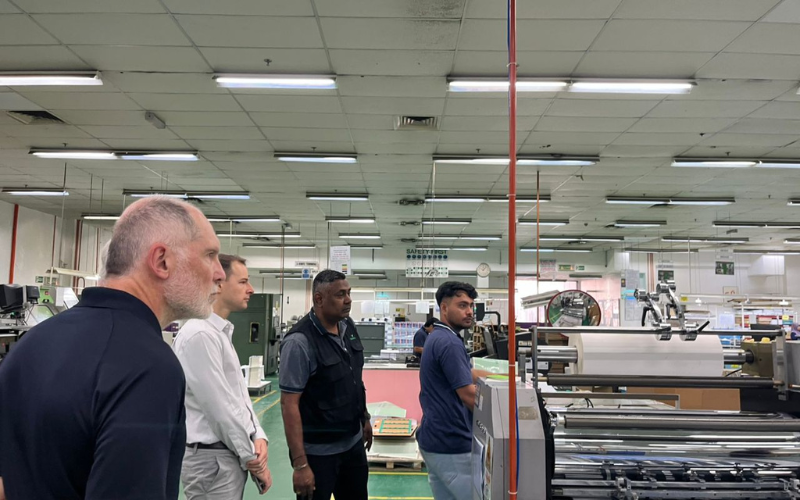 MoveToAsia’s sourcing team conducting a factory audit in Malaysia.
The 6 key advantages of sourcing in Malaysia compared to China
1) A relatively accessible operating environment for foreign companies
Malaysia generally offers a familiar environment for international businesses.
Foreign ownership is permitted in many manufacturing activities, and English is widely used across commercial, technical and administrative environments.
This can simplify:
-
supplier contracts;
-
technical discussions;
-
local company establishment;
-
recruitment;
-
documentation;
-
dispute management.
However, buyers should avoid assuming that regulations are automatically simple.
Sector-specific licensing, foreign-worker rules, customs requirements and investment incentives can still create complexity.
The advantage is better understood as relative accessibility for international teams, rather than an absence of bureaucracy.
2) A skilled and multilingual workforce
Workforce quality remains one of Malaysia’s strongest sourcing advantages.
The country has developed substantial engineering and technical talent through decades of multinational manufacturing investment.
English is commonly used in professional environments.
For sourcing projects, this can make communication around:
-
CAD drawings;
-
tolerances;
-
PPAP;
-
engineering change orders;
-
testing;
-
quality corrective actions;
-
documentation
more straightforward.
This does not mean every Malaysian supplier has excellent communication.
Technical capability must still be assessed supplier by supplier.
But Malaysia’s multilingual industrial environment can reduce one layer of sourcing friction.
3) Labor cost: focusing on total cost rather than hourly wages
Malaysia should not normally be selected solely because of labor cost.
China has automated aggressively, and some Chinese factories achieve extremely high productivity despite rising wages.
Meanwhile, Malaysia itself is experiencing wage increases and greater competition for technical workers.
The more relevant comparison is therefore total cost of ownership.
TCO can include:
**Unit manufacturing price
-
tooling
-
defects
-
rework
-
supplier management
-
travel
-
logistics
-
inventory
-
tariffs
-
delays
-
compliance risk**
For technically demanding products, the cheapest quotation does not necessarily create the lowest total cost.
Malaysia can be particularly competitive where:
-
volumes are medium rather than enormous;
-
quality failures are expensive;
-
engineering communication matters;
-
products have strict compliance requirements;
-
supply-chain diversification has strategic value.
4) Strong trade connectivity and regional access
Malaysia’s role as an ASEAN manufacturing base is one of its most important advantages.
Its FTA architecture combines ASEAN agreements, RCEP, CPTPP and bilateral agreements.
Malaysia has implemented 17 FTAs, and almost two-thirds of its 2025 trade was conducted with FTA partners.
This gives manufacturers access to a broad network of Asian and international markets, subject to applicable rules of origin.
For companies creating multi-country manufacturing strategies, Malaysia can therefore connect effectively with:
-
China;
-
Vietnam;
-
Thailand;
-
Singapore;
-
Japan;
-
South Korea;
-
Australia.
5) Diversification away from a single geopolitical exposure
Malaysia can help reduce dependence on any single manufacturing jurisdiction.
But companies should be careful not to interpret this as “Malaysia has no geopolitical risk.”
No sourcing country is politically or commercially risk-free.
Malaysia’s advantage lies in diversification itself.
For example, if a company already produces 90% of a product family in China, moving 20–30% of production to Malaysia may reduce concentration risk even if Malaysian costs are slightly higher.
This becomes particularly relevant for:
-
strategic SKUs;
-
regulated products;
-
US/EU-facing product lines;
-
components with high business-continuity importance.
Tariff treatment should always be verified by HS code, origin rules and destination market rather than assuming that products made in Malaysia automatically receive favorable treatment.
6) Modern infrastructure and efficient logistics
Malaysia’s infrastructure supports a highly trade-oriented economy.
Its manufacturing clusters benefit from:
-
Port Klang;
-
Port of Tanjung Pelepas;
-
Penang Port;
-
Kuala Lumpur International Airport;
-
Penang International Airport;
-
highways connecting industrial corridors;
-
free industrial zones.
The country recorded RM3.061 trillion in trade in 2025, illustrating the scale at which these logistics systems support international commerce.
For companies building regional supply chains, Malaysia’s proximity to Singapore can also be strategically useful.
Where China still clearly outperforms Malaysia
A credible comparison should acknowledge that China remains stronger in several areas.
Supplier ecosystem depth
China’s greatest manufacturing advantage may be the density of its supply chains.
Within the same industrial region, a buyer can often access:
-
raw-material suppliers;
-
component manufacturers;
-
tooling companies;
-
packaging;
-
finishing;
-
electronics;
-
mechanical parts;
-
logistics.
This can dramatically accelerate product development.
Malaysia’s supplier ecosystem is sophisticated but substantially smaller.
Certain components or raw materials still need to be imported, often from China itself.
Rapid prototyping and development
For many consumer and industrial products, China remains exceptionally effective at moving from:
concept → prototype → tool → sample → mass production
The density of engineering resources and subcontractors can make iteration extremely fast.
Malaysia can perform very well on industrialization, but China often remains stronger when a project requires repeated rapid iterations across many different suppliers.
Scale
China’s manufacturing economy is enormous.
In 2025, Chinese manufacturing generated approximately RMB34.67 trillion of value added, increasing 6.1% from 2024.
For products requiring millions of units, extremely deep supply chains or aggressive capacity ramp-up, China retains a structural advantage.
Product breadth
China can manufacture virtually every industrial category at scale.
Malaysia is more selective.
A sourcing company therefore needs to begin with product-market fit.
Malaysia may be excellent for semiconductor equipment but less compelling for a simple promotional consumer product.
Malaysia vs China: which country fits which sourcing project?
A useful decision framework is:
| Project Type | Better Starting Point |
|---|---|
| High-volume commodity consumer goods | China |
| Complex consumer electronics | China / Malaysia, depending on scale |
| Semiconductor-related manufacturing | Malaysia or China |
| Precision industrial equipment | Both should be assessed |
| Technical plastic components | Both |
| Medical-device manufacturing | Malaysia increasingly attractive |
| Low-volume customized industrial components | Malaysia can be attractive |
| Huge supplier ecosystem required | China |
| China+1 diversification program | Malaysia |
| ASEAN-focused manufacturing strategy | Malaysia |
| Extremely fast prototype ecosystem | China |
| High documentation / controlled manufacturing | Malaysia is particularly relevant |
The key message is simple:
Country selection should follow the product—not the other way around.
Malaysia vs China sourcing: limitations and challenges
More limited industrial scale than China
Malaysia’s industrial ecosystem is considerably smaller.
Buyers may find fewer suitable suppliers for:
-
niche technologies;
-
extremely specialized processes;
-
very large production volumes;
-
highly fragmented component ecosystems.
This makes supplier identification more important.
In China, procurement teams may sometimes find dozens of technically credible suppliers.
In Malaysia, the viable shortlist may be significantly smaller.
Partial dependence on imported raw materials and components
Malaysia is deeply integrated into Asian supply chains.
That is a strength, but also a dependency.
Certain:
-
electronic components;
-
steel products;
-
specialty chemicals;
-
machine components;
-
tooling inputs;
-
engineered materials
may still originate from China, Japan, Taiwan, South Korea or elsewhere.
This means that relocating final manufacturing from China to Malaysia does not necessarily remove China from the upstream supply chain.
Companies should map:
Tier 1 supplier → Tier 2 supplier → material origin → critical components
before claiming that a China+1 program has actually diversified supply-chain risk.
Smaller supplier choice can increase dependency
Malaysia’s specialization can sometimes create concentration at supplier level.
If only two or three factories can manufacture your product, changing supplier becomes more difficult.
Dual sourcing and supplier-development strategies therefore remain important.
China+1: why Malaysia is a preferred choice
Malaysia’s strongest role is often not as a full China replacement but as a second industrial pillar.
A China+Malaysia configuration can provide:
-
geographic diversification;
-
access to different trade agreements;
-
reduced country concentration;
-
access to ASEAN;
-
additional manufacturing capacity;
-
greater continuity planning.
Example 1: Electronics
A company might maintain high-volume PCBA production in China while establishing a second EMS source in Penang.
Example 2: Industrial machinery
Complex components can continue coming from established Chinese suppliers while welded structures, machining or selected assemblies are developed in Malaysia.
Example 3: Medical devices
A company may move selected regulated manufacturing into Malaysia to access the country’s established medical-device ecosystem while retaining commodity components in China.
Example 4: Regional ASEAN production
A company expanding into Southeast Asia may use Malaysia for technically demanding manufacturing while combining suppliers from Vietnam, Thailand and China.
This is a more sophisticated version of China+1.
Rather than simply moving one factory from Country A to Country B, companies design a regional manufacturing portfolio.
A practical China+1 roadmap
Companies considering Malaysia should avoid immediately sending every existing Chinese RFQ to Malaysian suppliers.
A better process is:
Step 1 – Map the current China supply chain
Identify:
-
product families;
-
spend;
-
critical suppliers;
-
raw-material origins;
-
tooling;
-
logistics;
-
lead times;
-
strategic components.
Step 2 – Identify products suitable for diversification
Prioritize products where:
-
concentration risk is high;
-
supplier switching is realistic;
-
volumes fit Malaysia;
-
quality is strategically important;
-
tariff or market-access benefits may exist.
Step 3 – Conduct Malaysian market feasibility
Determine whether the required:
-
materials;
-
processes;
-
certifications;
-
capacity;
-
engineering capabilities
actually exist locally.
Step 4 – Benchmark suppliers
Compare Malaysian candidates against existing Chinese suppliers using the same RFQ, quality and operational criteria.
Step 5 – Audit before transferring
A supplier should not become “China+1” simply because it submitted an attractive quotation.
Validate:
-
equipment;
-
capacity;
-
quality systems;
-
engineering;
-
subcontracting;
-
material sourcing;
-
financial stability.
Step 6 – Pilot before scaling
Begin with:
-
samples;
-
tooling;
-
small production runs;
-
controlled SKU transfer.
Only scale once quality and delivery performance are demonstrated.
Move To Asia’s role in your Malaysia sourcing strategy
At MoveToAsia, we support companies that want to evaluate Malaysia using a structured sourcing process rather than simply collecting supplier quotations.
 On-site factory audit in Malaysia by the MoveToAsia sourcing team.
Depending on the project, this can include:
-
manufacturing feasibility studies;
-
supplier identification;
-
supplier qualification;
-
RFQ management;
-
factory audits;
-
joint factory visits;
-
quotation benchmarking;
-
sampling;
-
production monitoring;
-
quality control.
For China+1 projects in particular, the objective is not simply to find “a Malaysian supplier.”
It is to determine:
Which parts of your current sourcing footprint can realistically be transferred, duplicated or complemented in Malaysia without creating new operational risks.
Conclusion: Malaysia vs China sourcing is now a long-term strategic decision
China remains one of the world’s most formidable manufacturing platforms.
Its US$6.35 trillion goods-trade economy, deep supplier networks, massive industrial capacity and sophisticated manufacturing infrastructure mean that it will remain central to global sourcing for the foreseeable future.
Malaysia offers something different.
The Malaysia-versus-China decision should therefore not be reduced to:
Which country is cheaper?
A more useful sourcing question is:
Which combination of countries gives us the strongest balance of cost, scale, quality, market access and supply-chain resilience?
For high-volume manufacturing, rapid product development and supplier depth, China will often remain difficult to beat.
For selected electronics, medical, industrial, precision and technically controlled manufacturing programs—and particularly for companies trying to reduce excessive China concentration—Malaysia increasingly deserves a place in the sourcing strategy.
The future of Asian sourcing is therefore unlikely to be China or Malaysia.
For many international manufacturers, it will increasingly be:
China + Malaysia + a carefully designed regional supplier network.
If you are currently dependent on China and considering Malaysia as part of a China+1 strategy, MoveToAsia can help you assess which products are genuinely suitable for diversification, benchmark Malaysian manufacturing capabilities against your existing suppliers, and build a practical supplier qualification roadmap before committing to a production transfer.
FAQ – Malaysia vs China Sourcing
Is Malaysia cheaper than China for manufacturing?
Not necessarily.
Malaysia should generally not be viewed as a low-cost substitute for China.
For technically demanding products, however, total costs can become competitive once productivity, quality, supplier management, compliance, logistics and diversification value are considered.
When does China still clearly outperform Malaysia?
China remains particularly strong for:
-
extremely high-volume manufacturing;
-
commodity products;
-
complex consumer products involving many different supplier tiers;
-
rapid prototyping;
-
projects requiring very deep local supply chains.
Which product categories are particularly suitable for Malaysia?
Malaysia is especially relevant for:
-
electronics and semiconductors;
-
electrical equipment;
-
medical devices;
-
machinery and equipment;
-
precision engineering;
-
technical plastics;
-
automotive components;
-
selected metal and aluminium manufacturing.
Is Malaysia a good China+1 destination?
Yes, particularly for companies whose existing Chinese supply chains involve technically demanding, higher-value products.
However, a proper feasibility study should be completed first. Not every Chinese product category can be competitively duplicated in Malaysia.
Does moving manufacturing to Malaysia eliminate China dependency?
Not necessarily.
A Malaysian manufacturer may still source components, tooling or materials from China.
Companies should therefore analyze Tier 2 and raw-material origins when evaluating genuine supply-chain diversification.
Does Malaysia have trade advantages over China?
Malaysia and China both participate in RCEP, but Malaysia is also a member of the CPTPP and numerous ASEAN and bilateral FTAs.
Malaysia currently has 17 implemented FTAs, which can create market-access advantages depending on destination, HS classification and applicable rules of origin.
Are Malaysian factories accustomed to exporting?
Yes.
Malaysia is one of the region’s most trade-oriented economies. Exports reached a record RM1.607 trillion in 2025, while total trade exceeded RM3 trillion for the first time.
However, export experience should still be verified at individual supplier level.
How should companies split production between China and Malaysia?
There is no universal percentage.
A company might keep high-volume and highly localized production in China while using Malaysia for:
-
critical product lines;
-
regulated products;
-
second-source capacity;
-
higher-value manufacturing;
-
ASEAN-oriented programs.
The allocation should follow a product-by-product risk and cost analysis.
Should companies close their Chinese suppliers when moving to Malaysia?
Usually not immediately.
For most China+1 programs, maintaining the established Chinese supplier while developing and validating the Malaysian alternative provides much lower transition risk.
Once the Malaysian supplier has demonstrated consistent performance, production allocation can be adjusted progressively.
Do companies need local sourcing support in Malaysia?
For complex industrial projects, local supplier identification and factory verification can significantly accelerate the process.
The important value is not simply finding names of factories online, but determining which companies genuinely possess the required technical capabilities, capacity, quality systems and commercial fit.