


This guide explores the latest market data, identifies the fastest-growing consumer segments, and examines the key opportunities and considerations for businesses planning to enter Cambodia’s evolving consumer goods market.
Cambodia’s Consumer Goods & Retail Market in 2026
Cambodia’s consumer goods market continues to expand, supported by urbanization, rising household incomes, stronger digital connectivity, and ongoing investment in modern retail infrastructure. Although economic growth is expected to moderate slightly in 2026, long-term consumption trends remain favorable, particularly as organized retail and online commerce continue gaining market share.
According to 6Wresearch, Cambodia’s retail and wholesale market will grow at 7.4% CAGR from 2026 through 2032, as there will be more consumer activity and investment in retail & distribution networks across the nation. Other estimates include MarkWide Research which, according to different methods, shows more market growth, but likewise agrees to sustained growth of Cambodian consumers.
Digital commerce is becoming one of the market’s strongest structural drivers. Cambodia’s e-commerce market reached approximately US$1.78 billion in 2025, growing by nearly 18% year on year, as more consumers adopt online shopping and businesses expand their digital sales channels. This creates opportunities not only for consumer brands but also for distributors, logistics providers, and digital commerce enablers.
Investors should pay attention to the rest of the world and the state of the economy. The IMF estimates GDP growth in Cambodia will drop to 4.0% in 2026, from 4.8% in 2025. In the short term, demand for essential consumer goods will likely continue despite the economic slowdown. Demand for affordable branded products will also likely continue.
In Cambodia, the consumer goods market is seeing persistent alterations caused by consumer behavior and retail modernization compared to the more temporary economic changes that other markets are experiencing. This means that for investors, the demand for consumer goods will be closely related to the distribution channels as opposed to the investor’s ability to time the market effectively.
The Key Opportunities
Cambodia’s consumer market is becoming increasingly diversified, creating opportunities across retail, branded products, digital commerce, and distribution infrastructure. Rather than focusing solely on market size, investors should identify which segments are benefiting most from changing consumer behavior and retail transformation.
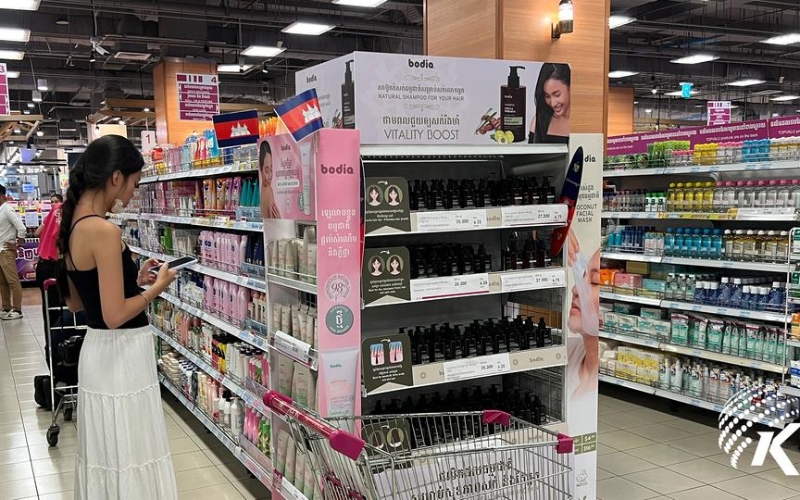
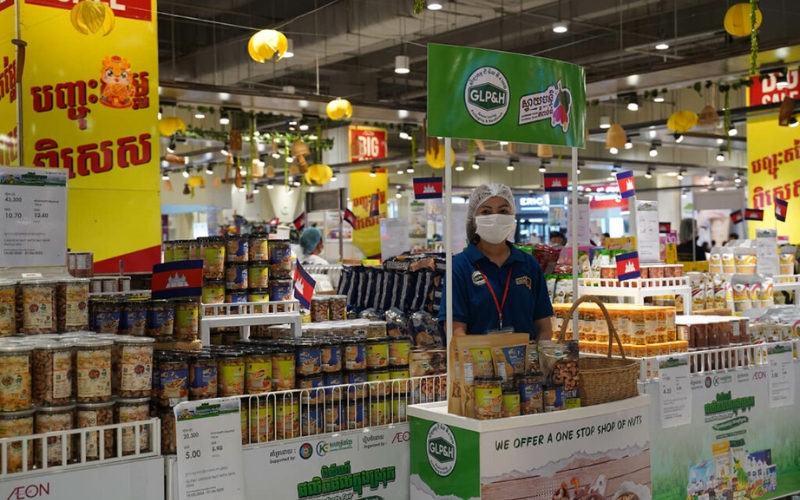
A clear opportunity is the sustained growth of contemporary retail. There is a noticeable preference shift by consumers towards supermarkets, hypermarkets, and structured retail formats. Both international and local market players such as AEON, Makro Cambodia, Lucky Supermarket Group, Chip Mong Retail and Thai Huot Market have been expanding their networks. These local market retailers present foreign companies with ways to market in those areas by means of supplier partnerships, private label manufacturing, franchising, or direct distribution of their products.
The fast-moving consumer goods (FMCG) segment also continues to demonstrate healthy growth. Beauty and personal care products have benefited from rising household incomes, greater brand awareness, and increasing demand among younger consumers. Personal hygiene products, including tissues and household care items, continue to record stable demand as urbanization and health awareness improve. Meanwhile, although tobacco consumption has gradually declined, traditional tobacco products remain the largest category within Cambodia’s tobacco market, illustrating that mature product categories still represent substantial commercial opportunities.
Digital commerce has become the fastest-growing sales channel for consumer brands entering Cambodia. Unlike many developed markets where online sales are concentrated on dedicated e-commerce platforms, Cambodian consumers frequently purchase products through Facebook, TikTok, and Telegram. Social commerce has therefore become an essential component of market entry rather than an optional marketing channel. Businesses that integrate live selling, influencer marketing, and direct messaging into their sales strategy are generally better positioned to reach younger consumers and respond quickly to changing purchasing trends.
Wholesale and distribution services are becoming increasingly important as organized retail and e-commerce continue expanding. Industry forecasts indicate that non-durable goods merchant wholesalers will remain the dominant segment within Cambodia’s wholesale market, supported by stronger demand from supermarkets, convenience stores, and digital retailers. As supply chains become more sophisticated, opportunities are also emerging in inventory management, regional distribution centers, and temperature-controlled storage for food and beverage products.
A foreign investment opportunity does not always mean starting a consumer brand in a foreign country. It could mean building an efficient distribution network abroad, aligning with a retailer abroad, or establishing logistics abroad to support retail. These opportunities could have great long-term benefits while reducing the costs to do marketing and acquire customers.
Another strategic insight is the emergence of the two-speed consumer market in Cambodia. Many industry executives have noticed that the businesses that have found success are the businesses that do not limit themselves to only one of the two extremes (high price/premium, low price). Many of these successful businesses have created value-oriented products (targeting price-sensitive families) in addition to their high-end products in order to capture urban middle-income customers. Resilience to slower economic growth is achieved through broader market demand.
As Cambodia’s retail landscape continues to modernize, companies capable of combining strong distribution, digital engagement, and carefully targeted product portfolios are likely to be best positioned for sustainable long-term growth.
Legal Framework & Foreign Investment Rules
Cambodia maintains one of the most open foreign investment regimes in Southeast Asia, making it relatively straightforward for international companies to establish operations in the consumer goods sector. Under the Law on Investment (2021), foreign investors are generally permitted to establish businesses with 100% foreign ownership, without the need for a local partner or nominee shareholder. Most companies enter the market by registering a private limited company, allowing full control over ownership, management, and business operations.
However, investors should differentiate between manufacturing and retail due to the substantial differences in incentives. While foreign firms may undertake wholesale, retail, and distribution freely, these sectors are included on Cambodia’s negative list with the investment sub-decree. Consequently, while fully open to foreign investors, the retail, wholesale, and duty-free trading sectors will not be offered Qualified Investment Project (QIP) tax incentives. While assessing project economics, many investors assume that all foreign investments qualify for tax holidays.
Manufacturing projects, on the other hand, may benefit from the Qualified Investment Project (QIP) scheme administered by the Council for the Development of Cambodia (CDC). Production activities, including food and beverage processing, garment manufacturing, footwear, textiles, and selected consumer goods manufacturing, may qualify for incentives if they meet the applicable investment criteria. For many manufacturing categories, the minimum investment threshold is US$500,000.
Approved QIP projects can receive a range of fiscal incentives, including corporate income tax exemptions of three to nine years, depending on the project’s classification. Investors may also benefit from exemptions on customs duties and VAT for imported production equipment, machinery, and certain construction materials, helping reduce upfront capital costs for manufacturing facilities.
Foreign-owned businesses must also satisfy Cambodia’s company registration requirements. The statutory minimum paid-up capital for a foreign-owned company is KHR 4 million (approximately US$1,000). While this satisfies the legal requirement, investors should ensure that registered capital accurately reflects the intended scale of operations. Financial institutions, government agencies, suppliers, and commercial partners often expect capitalization that is appropriate for the size of the proposed business, particularly for importers, manufacturers, and nationwide distributors.
Tax planning is another key consideration for companies entering the market. Businesses that do not qualify for QIP incentives are generally subject to Cambodia’s standard 20% corporate income tax. Most consumer products are also subject to Value Added Tax (VAT) of up to 10%, while import duties generally range from 0% to 35%, depending on the product category and applicable tariff classification. Understanding these obligations is essential for accurately modeling product pricing, import costs, and profit margins.
Cambodia is also implementing various new regulations to better facilitate digital commerce. According to the Digital Economy and Society Policy Framework 2021 – 2035, the government has made VAT registration simpler for online businesses, created new regulations regarding e-commerce trust marks, and developed a one-stop online business registration system. These improvements help new digital businesses of all brands and retailers become operational, while also helping maintain an easier, clearer regulatory compliance system.
Risks, Challenges & Practical Guidance for Investors
Although Cambodia’s consumer goods market offers attractive long-term growth prospects, investors should adopt a balanced approach that considers both market opportunities and operational risks.
One of the most visible challenges in 2026 was the Cambodia–Thailand border dispute, which temporarily disrupted cross-border trade, increased transportation costs, and affected inventory planning for many import-dependent businesses. While the disruption is not expected to permanently alter Cambodia’s growth trajectory, it highlights the importance of building resilient supply chains and avoiding excessive dependence on a single sourcing or transport route.
Companies also need to realize that the market system in Cambodia can’t stay the same forever. Some problems will still persist, like significant complications with licensing and tax pay administration, and other legal commercial regulations will still be an inconvenience. Laws about consumer protection are also following suit, and people in those industries are advocating for the legislation to be stricter and to have more enforcement. Some current consumer protection initiatives, like the EuroCham FMCG Forum, will help drive improvements to regulations about illegal trade. Regulatory reforms are advancing consumer protection, and more reforms are anticipated during the next few years.
Digital-first companies should pay attention to elements of Cambodia’s e-commerce in addition to the fast changing online sales. Outside major cities e-commerce logistics are underdeveloped compared to the rest of ASEAN markets. Delivery costs are generally higher, infrastructure quality across provinces is inconsistent, and customer concerns surrounding online fraud affect consumer confidence. To avoid the high costs of developing their own delivery networks to serve the market, companies often partner with third-party logistics providers.
Affordability is another important consideration. With GDP per capita at approximately US$1,760 and economic growth expected to moderate to 4.0% in 2026, purchasing decisions are becoming increasingly value-conscious. Consumers continue to seek quality products, but price sensitivity remains high across many product categories. As a result, companies that combine value-oriented product lines with selective premium offerings are often better positioned than businesses targeting only the premium segment.
Short-term economic moderation and temporary disruptions to supply lines across the globe have affected the prospects of some economies. In the case of Cambodia, the effect on long-term consumption has been favorable. Projections on retail growth at 7.4% on a Compound Annual Growth Rate (CAGR) basis; expansion on the consumer sector at close to 10% CAGR; and sustained double-digit e-commerce growth signify a shift in the patterns of consumer demand that is more diverse and digitally-centered. For foreign investors in 2026, the focus will shift to the market and more critically the segment in Cambodia that requires the most effective rate of differentiation in distribution and pricing.
Conclusion
Cambodia’s consumer goods market continues to offer compelling long-term opportunities, supported by rising household incomes, rapid retail modernization, and one of Southeast Asia’s fastest-growing e-commerce ecosystems. While investors should carefully navigate regulatory requirements, evolving consumer preferences, and short-term supply chain challenges, the market’s structural growth drivers remain intact. Success will depend on selecting the right business model, building resilient distribution networks, and aligning product offerings with local purchasing power. For companies that combine strong market research with a well-planned entry strategy, Cambodia presents a promising destination for sustainable growth in the consumer goods sector.