


This guide examines the industry’s current position, explores its competitive advantages, and outlines the key factors businesses should consider when evaluating Cambodia as part of a broader sourcing and manufacturing strategy.
Cambodia’s Garment & Textile Sector
The garment and textile industry remains Cambodia’s largest export-oriented manufacturing sector and one of the country’s most important economic pillars. Over the past three decades, it has evolved from a labor-intensive production base into a mature export ecosystem that supports international apparel brands, footwear manufacturers, and travel goods producers serving markets across North America, Europe, and Asia.
Although Cambodia has diversified into electronics, automotive components, and food processing in recent years, the Garment, Footwear, and Travel Goods (GFT) industry continues to be the country’s leading manufacturing export sector. According to Cambodia’s Ministry of Commerce, GFT exports reached a record US$15.7 billion in 2025, reflecting the sector’s continued resilience despite ongoing uncertainty in global consumer demand.
The industry’s production base has also become more diversified. While apparel remains the dominant product category, footwear and travel goods have expanded rapidly as international brands broaden their sourcing strategies and manufacturers move into higher-value product segments. This gradual diversification is helping Cambodia strengthen its position within global supply chains while reducing reliance on a single product category.
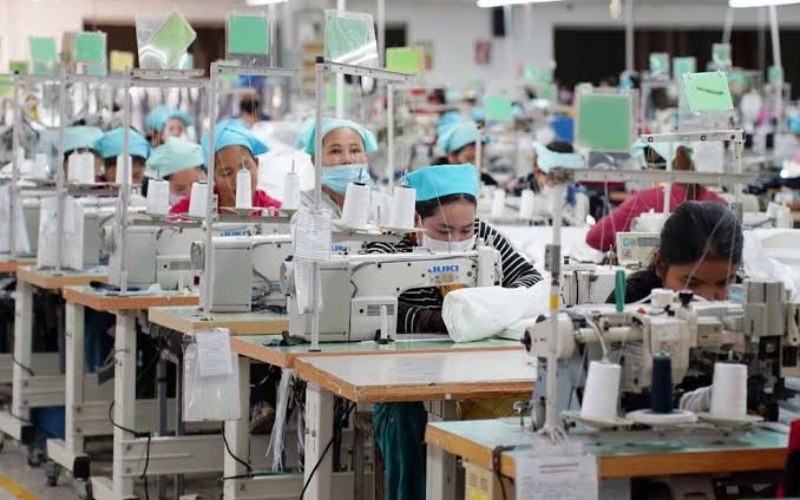
Scale remains one of Cambodia’s strongest competitive advantages. The country is home to approximately 1,800 factories employing around 1.1 million workers, creating one of Southeast Asia’s largest labor-intensive manufacturing ecosystems. This concentration of production capacity allows international buyers to access experienced suppliers alongside an established network of logistics providers, quality inspection services, and export infrastructure.
Looking ahead, Cambodia is expected to remain an important component of regional “China+1” sourcing strategies. As manufacturers continue diversifying production across Asia, the country offers a combination of competitive operating costs, an experienced workforce, and a mature export ecosystem that supports long-term sourcing and manufacturing decisions.

Why Manufacturers & Brands Source from Cambodia
Cost competitiveness remains one of the primary reasons international brands continue sourcing from Cambodia, but it is no longer the only consideration. Today, purchasing decisions increasingly balance production costs with trade preferences, supplier reliability, compliance standards, and supply chain resilience. Cambodia continues to perform well across these areas, reinforcing its role as a strategic sourcing destination rather than simply a low-cost manufacturing base.
Labor costs remain highly competitive within Southeast Asia. Effective 1 January 2026, the minimum monthly wage in the garment, footwear, and travel goods sector increased to US$210, representing only a modest annual adjustment that helps manufacturers maintain cost predictability. Mandatory employer social security contributions also remain relatively low, allowing businesses to manage overall employment costs while supporting workforce stability.
Access to trade makes Cambodia more competitive. Trade agreements like RCEP, Cambodia–China Free Trade Agreement, and regional ASEAN trade agreements give manufacturers preferential access to major markets. Cambodia continues to enjoy preferential treatment from the European Union under the Everything But Arms (EBA) scheme, providing more opportunities to export to European customers. This preferential treatment offers export-oriented manufacturers additional advantages.
Compliance is the new competitive differentiator. The Better Factories Cambodia (BFC) program, which promotes transparency and social compliance, is quickly becoming a world-class program. The BFC program, which provides certainty and reduces the risk of poor supply chain compliance and reputation to international brands with growing concerns for environmental social governance (ESG) compliance, will make the selection of a BFC program-compliant sourcing partner less challenging.
Industrial infrastructure has also improved significantly. More than 20 operational Special Economic Zones provide manufacturers with factory-ready facilities, customs support, reliable utilities, and improved transport connectivity. These industrial clusters enable businesses to establish production more efficiently while benefiting from integrated export infrastructure and proximity to major logistics corridors.
Finally, Cambodia’s exporting variety lessens the reliance on a certain market. The United States is still the most prominent purchaser of Cambodia’s GFT products, but exports to the European Union, Japan, Canada, China, and other nearby markets are getting higher. More customers mean a stronger industry. In turn, GFT manufacturers can adapt to global demand more easily.
Cambodia is a popular place to set up factories compared to other countries in the region. The flexibility to use the lowest cost exports is beneficial, but not enough to gain international business. Cambodia’s appeal to international manufacturers relies on combining low costs, flexible regulations, easy market access, and the ability to cooperate with ready suppliers that connect global brands to sourcing strategies in a timely manner.
Investment Opportunities
Although Cambodia has established itself as one of Asia’s leading apparel production hubs, much of the industry’s value chain remains concentrated in Cut-Make-Trim (CMT) manufacturing. Most factories specialize in assembly, while higher-value upstream activities, including fabric production, weaving, dyeing, finishing, and textile treatment, remain underdeveloped. For investors, this structural imbalance represents one of the country’s largest industrial opportunities.
Industry estimates suggest that in 2025, manufacturers imported textile inputs valued at approximately US$8.7 billion, constituting nearly 60% of the entire production needs. Yarns, fabrics, and other textile accessories and intermediate goods are sourced predominantly from China and regional suppliers to be assembled in Cambodia. Although the framework has provided significant export growth, manufacturers are increasingly burdened with higher costs related to logistics, lead times, and the changing global landscape of trade compliance.
Establishing capacity for production is critical. Investment is needed to create operations for weaving, dyeing, and finishing, as these would increase control over the entire supply chain and improve the ability to respond to consumers in a timely manner. Furthermore, these would likely qualify for special assistance under the CDC’s (Council for the Development of Cambodia) system of priority investments. This is consistent with the goals of the government to create a more cohesive industrial system rather than one dependent on assembly operations.
This strategy is further supported by plans to establish a dedicated textile Special Economic Zone (SEZ) focused on attracting fabric, yarn, and supporting material producers. The initiative aims to strengthen local sourcing capacity ahead of Cambodia’s expected graduation from Least Developed Country (LDC) status, when stricter rules of origin are likely to play a greater role in determining preferential market access. Increasing domestic input production will therefore become increasingly important for maintaining export competitiveness over the coming decade.
Beyond upstream production, sustainability is emerging as another major growth area. International brands are placing greater emphasis on carbon reduction, resource efficiency, and responsible sourcing throughout their supply chains. For manufacturers, improving environmental performance is no longer simply a compliance exercise; it is becoming a commercial requirement for securing long-term sourcing contracts.
Research by the Global Green Growth Institute (GGGI) indicates that improving energy efficiency by 20% across the sector could increase overall energy productivity by 31% by 2030, while avoiding approximately US$2 billion in cumulative energy costs. Achieving these gains will require investment in rooftop solar systems, energy-efficient machinery, wastewater treatment, heat recovery technologies, and digital energy management systems. Industry estimates suggest that the potential market for clean energy upgrades alone could reach US$120–150 million over the next 15 years.
Footwear manufacturing represents another promising opportunity. As the fastest-growing category within Cambodia’s GFT exports in 2025, footwear offers greater value-added potential than traditional cut-and-sew production while benefiting from rising global demand and increasing participation by international sportswear brands. Businesses supplying specialized materials, technical components, molding technologies, or advanced production equipment may therefore find stronger long-term growth prospects in this segment.
At the same time, the government is encouraging broader adoption of Industry 4.0 technologies, including factory automation, digital production management, environmental certification, and supply chain traceability. These capabilities are becoming increasingly important as global buyers seek greater visibility across supplier networks and demand higher standards of quality, sustainability, and compliance.
This transition is also supported by the growing international presence of Cambodia. Cambodia’s selection to host the OECD inaugural Regional Forum on Garment and Footwear Due Diligence in Asia in April 2027 shows increasing confidence in Cambodia’s efforts to strengthen the responsible business and supply chain on guard. For companies investing beyond basic assembly, this implies a transition to a market of higher value, technology-based manufacturing.
Investment Framework and Trade Risks
Establishing production in Cambodia has become increasingly straightforward, supported by an open foreign investment regime and a range of fiscal incentives for export-oriented manufacturing. Nevertheless, successful market entry depends on more than securing tax benefits. Businesses must also evaluate evolving trade policies, supply chain resilience, and long-term competitiveness before committing capital.
Most manufacturing projects are first registered with the Council for the Development of Cambodia (CDC) under the Qualified Investment Project (QIP) framework. Projects that are registered under the QIP framework are eligible to receive corporate income tax exemptions for a period of up to nine years. In addition, these projects are also eligible to receive exemptions on the import duties of production equipment and construction materials, VAT incentives for selected inputs that are sourced locally, and enhanced deductions for research and development, and for activities that are conducted to develop the workforce and provide vocational training. These incentives are designed to promote industrial upgrading and higher value production, rather than assembly-based activities.
Companies must also determine whether to establish operations within a Special Economic Zone (SEZ) or develop a standalone facility. SEZs generally offer faster project implementation through integrated infrastructure, customs facilitation, and one-stop administrative services, making them particularly attractive for export-oriented manufacturers. Larger projects requiring customized layouts or significant future expansion may instead favor standalone developments despite longer implementation timelines.
Participation in industry organizations also plays an increasingly important role. Membership of the Garment Manufacturers Association in Cambodia (GMAC) provides businesses with industry representation, regulatory updates, and networking opportunities, while engagement with Better Factories Cambodia (BFC) helps demonstrate compliance with internationally recognised labour and workplace standards. For suppliers serving global brands, these programmes can strengthen buyer confidence and improve access to long-term sourcing partnerships.
Despite these advantages, investors should carefully evaluate several structural risks.
Trade policy remains the most immediate uncertainty. Following reciprocal tariff measures announced by the United States in 2025, Cambodia was initially assigned a 49% tariff rate, later reduced to a negotiated level of 19% while discussions continue. Although exports to the US remain strong, uncertainty surrounding future trade arrangements has affected order planning across parts of the industry, with many factories reporting shorter production visibility than in previous years.
A second strategic consideration is Cambodia’s planned graduation from Least Developed Country (LDC) status by 2029. Preferential access under the European Union’s Everything But Arms (EBA) scheme is expected to phase out gradually over the following years, meaning exporters will increasingly need to satisfy stricter rules of origin under alternative trade arrangements such as GSP or GSP+. This transition further reinforces the importance of expanding domestic fabric and yarn production to reduce reliance on imported inputs.
Resilience among suppliers and their distribution networks should also be carefully assessed. About 60% of the necessary production materials come from international suppliers. Therefore, manufacturers are subjected to the barriers of international shipping and changes in worldwide freight. The border interruptions between Cambodia and Thailand make it evident that export-oriented businesses need to have flexible logistics systems.
Finally, being cost competitive is no longer just the function of cheap labor. At the Cambodia Textile Summit 2026, which involved members of the government, multinational agencies and businesses, the consensus during the sessions was that low labor costs will be the least of issues to ensure businesses are successful in the future. The focus will be on productivity and the required skills, sustainability and compliance, as well as the supply chains.
From an investment perspective, the positive outlook will be sustained. Cambodia will continue to strengthen its position as a primary export platform. However, it will be the businesses with the capacity to balance higher value exports with better productivity and operational efficiency that will enjoy the greater advantage in the future.
Conclusion
Cambodia’s garment and textile industry remains one of Southeast Asia’s most established export manufacturing ecosystems, supported by decades of production experience, competitive operating costs, and strong integration into global apparel supply chains. Continued export growth in 2025 and positive investment momentum heading into 2026 demonstrate that the sector remains attractive despite an increasingly competitive regional landscape.
At the same time, the industry is entering a new phase of development. Future growth will depend less on expanding assembly capacity and more on strengthening upstream production, improving sustainability performance, adopting digital technologies, and increasing domestic value addition. These structural changes are creating new opportunities not only for apparel manufacturers but also for suppliers of fabrics, industrial equipment, clean energy solutions, factory automation, and advanced production technologies.
When assessing any prospects for doing business in Cambodia, companies should go beyond the examination of labor costs. As global sourcing demands change, supply chain robustness, trade agreements, compliance capability, and infrastructure and policy position and levers will dictate competitiveness.
For businesses aiming to spread out their manufacturing in Asia, Cambodia is much more than another manufacturing site for the region. It is an increasingly appealing combination of a manufacturing site and developing higher value, more resilient, sustainable manufacturing. There are therefore new business opportunities for the companies that plan for the future and invest strategically.