


How to read Malaysia’s halal opportunity
Malaysia is one of the world’s most developed halal ecosystems, but its investment case is more specific than the headline market size suggests. Halal exports reached RM68.52 billion (US$17 billion) in 2025, up 10.9% year on year and equal to 4.3% of Malaysia’s total exports. Food and beverages contributed RM36.86 billion (US$9.12 billion) and halal ingredients RM21.39 billion (US$5.3 billion), together accounting for about 85% of the export total.
The global demand base is also expanding. Muslim consumer spending across six Islamic-economy sectors reached US$2.60 trillion and is projected to reach US$3.56 trillion by 2029. Halal food alone is forecast to increase from US$1.53 trillion to US$2.06 trillion over the same period, while halal pharmaceuticals and cosmetics are projected to reach US$146 billion and US$124 billion respectively.
These figures make Malaysia relevant as both a domestic market and an export platform. The country’s population was estimated at 34.4 million in the first quarter of 2026, and Islam is the religion of 63.5% of the population. Domestic demand therefore supports certification and product development, while Malaysia’s standards, industrial base, ports and regional trade relationships can support wider ASEAN and Organisation of Islamic Cooperation markets.
However, halal certification does not replace normal commercial due diligence. A product may be technically certifiable but uncompetitive, difficult to register, dependent on poorly documented ingredients or unsuitable for target export markets. Investors should evaluate the customer, product, facility, supply chain and certification route together.
Investor takeaway: Malaysia is most attractive when certification credibility is combined with a defined export market, traceable inputs and a staged entry model. Certification by itself is not a substitute for demand validation or regulatory approval.
Malaysia’s strategic position in the halal economy
Malaysia retained first place in the Global Islamic Economy Indicator, ahead of the United Arab Emirates, Saudi Arabia, Indonesia and Bahrain. The ranking reflects the breadth of the country’s Islamic-economy ecosystem rather than the competitiveness of every individual product category. For investors, the practical advantages are institutional familiarity, established certification procedures, specialist talent, testing and training capacity, and an industrial ecosystem that already serves multinational and local companies.
The Halal Industry Master Plan 2030 provides the policy direction. It identifies 23 initiatives across seven strategic thrusts, including policy and legislation, market access, talent, integrated infrastructure, thought leadership and the development of Malaysian halal champions. The plan projected a halal-industry value of US$113.2 billion by 2030, but investors should treat this as a policy ambition rather than a guaranteed market outcome.
Dedicated infrastructure is visible in Malaysia’s HALMAS-status halal parks. Fourteen parks recorded cumulative investment of RM16.75 billion (US$4.14 billion) between 2012 and 2024 and hosted 361 companies, including 51 multinational corporations. Yet only 841.18 hectares, or 15.3% of the land designated for trade and investment activity, had been developed. The data indicate both ecosystem depth and an execution gap: a halal-park location can simplify access to specialised infrastructure, but it does not automatically guarantee suppliers, labour, utilities or customers.
| Indicator | Latest evidence | What it means for investors |
| Halal exports | RM68.52bn (US$17 bn) in 2025; +10.9% year on year | A meaningful export base, although growth is concentrated in food, beverages and ingredients. |
| Global demand | US$2.60tn ; projected US$3.56tn by 2029 | Demand is expanding across food, travel, pharmaceuticals, cosmetics and enabling services. |
| Domestic market | 34.4m population in Q1 2026; Islam represented 63.5% | Local demand can support product validation, but consumer segments and price points still need testing. |
| Global ecosystem position | Malaysia ranked first in the 2025/26 Global Islamic Economy Indicator | Institutional credibility is an advantage, not an assurance of product-market fit. |
| HALMAS infrastructure | 14 parks; RM16.75bn (US$4.14 bn) cumulative investment, 2012-2024 | A location option for manufacturing and export projects, subject to site-level due diligence. |
Where the strongest investment opportunities are in Malaysia
1. Halal food, beverages and high-value ingredients
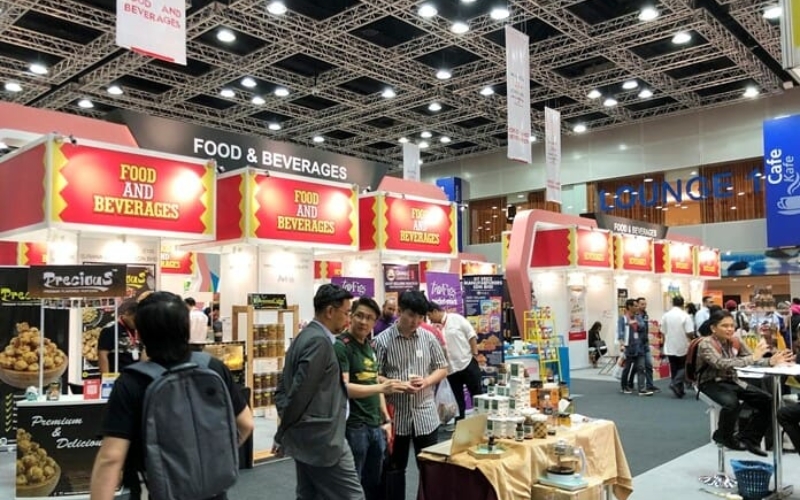
Food, beverages and ingredients are Malaysia’s most proven halal export categories. The opportunity is not limited to finished consumer products. It includes flavour systems, functional ingredients, plant-based inputs, emulsifiers, enzymes, nutraceutical components, packaging, testing and contract manufacturing. Foreign companies with proprietary formulations or differentiated processing technology can use Malaysia to localise production and serve regional customers.
The more defensible projects solve a clear supply-chain problem. Examples include replacing imported ingredients with traceable regional alternatives, creating export-compliant formulations for multiple Muslim markets, or providing private-label production to retailers and brand owners. Mass-market packaged food can be highly competitive, so investors need evidence of distributor reach, shelf economics, repeat purchase and raw-material continuity before adding capacity.
2. Pharmaceuticals, nutraceuticals, medical products and cosmetics
Halal pharmaceuticals and cosmetics offer higher-value opportunities, particularly where halal assurance supports an existing clinical, functional or brand proposition. DinarStandard projects global Muslim spending on pharmaceuticals to rise from US$112 billion to US$146 billion in 2029, while cosmetics are projected to grow from US$92 billion to US$124 billion. Malaysia can be relevant for supplements, over-the-counter products, personal care, clean-label cosmetics, medical consumables and selected medical devices.
The barrier to entry is correspondingly higher. Halal status does not replace product registration, safety, quality or manufacturing requirements. Medicinal products are regulated through the National Pharmaceutical Regulatory Agency (NPRA), and cosmetics must be notified before marketing. A foreign cosmetics company must appoint a Malaysia-registered local agent to hold the notification; a halal logo is voluntary but may only be used after appropriate halal certification. This favours companies that can coordinate regulatory, quality and halal workstreams from the beginning.
3. Halal logistics, traceability and compliance technology
As halal value chains become more international, the commercial need shifts from a certificate at the factory gate to verifiable control across sourcing, storage, transport and distribution. Opportunities include segregated warehousing, cold chain, ingredient-documentation platforms, supplier-risk tools, laboratory services, digital audit trails and recall systems. Malaysia’s standards portfolio covers halal supply-chain activities including transportation, warehousing and retailing, creating a recognised framework for service providers.
Asset-light technology and professional services can be attractive entry points because they address a system-wide need without requiring immediate consumer-brand investment. The strongest offerings integrate with procurement and quality systems, generate audit-ready evidence and can be adapted to the documentation requirements of different export destinations.
4. Contract manufacturing, OEM and halal-park production
Malaysia’s established food, pharmaceutical and personal-care manufacturing base creates opportunities for foreign brands to enter through contract manufacturing or original-equipment manufacturing before building their own plants. This approach can reduce capital exposure and shorten the learning cycle, provided the manufacturer’s certification scope, ingredient controls, capacity, quality systems and export history are verified.
A greenfield facility becomes more credible when production volumes, customer commitments and target-market requirements are already known. HALMAS parks may offer ecosystem and facilitation benefits, but investors should compare them with conventional industrial sites on utilities, logistics, labour, supplier proximity, land terms and expansion flexibility. For manufacturing businesses with shareholders’ funds of RM2.5 million (US$17 million) or more, or 75 or more full-time paid employees, a manufacturing licence is generally required under the Industrial Co-ordination Act 1975.

| Segment | Why Malaysia can work | Suitable entry model | Main execution test |
| Food and beverages | Large existing export base and domestic Muslim demand | Distributor pilot, OEM, local production | Price point, channel access and repeat purchase |
| Ingredients and processing inputs | Demand from local and export-oriented manufacturers | B2B sales, technical partnership, local blending | Traceability, technical approval and customer qualification |
| Pharma, nutraceuticals and cosmetics | Growing global demand and established regulatory institutions | Local agent, contract manufacturing, specialised facility | Parallel halal, product-registration and quality compliance |
| Logistics and traceability | Need for chain-of-custody evidence and segregation | Software, laboratory, 3PL or advisory partnership | Integration with real operational workflows |
| OEM and halal-park manufacturing | Existing industrial infrastructure and experienced suppliers | Contract manufacturing, JV or staged greenfield | Site economics, certification scope and committed volume |
Malaysia’s halal certification and regulatory framework
Malaysia’s halal framework is credible partly because it is formal and enforceable. It also means investors should not treat certification as a final-stage packaging task. The relevant product, premises, ingredients, equipment, cleaning procedures, personnel, records and supply-chain controls need to be designed into the operating model.
When halal certification is required
Halal certification is not universally compulsory for every product sold in Malaysia. However, when a product, food premise or service is described or marked as halal, the representation must comply with the Trade Descriptions framework. Malaysian halal certification is issued by the competent Islamic authorities, while imported products marketed as halal must be certified by a foreign halal-certification body recognised by JAKIM. Investors should verify the live recognised-body list because recognition can be added, amended or withdrawn.
For international manufacturing arrangements, JAKIM offers schemes for food products, cosmetics, pharmaceuticals, consumer goods and medical devices. Applications are open to Malaysia-registered branches, subsidiaries, importers, distributors, traders and agents, which makes entity and channel structure part of the certification strategy.
The operating system behind the certificate
The Malaysian Halal Management System distinguishes between an Internal Halal Control System for micro and small industry and a Halal Assurance System for medium and large industry. The latter covers halal policy, an internal halal committee, internal audit, raw-material control, training, traceability, system review, laboratory analysis where relevant and cleansing procedures. These requirements make procurement and change control central: a new ingredient, supplier, contract manufacturer or production line can affect certification status.
Certificate validity depends on the scheme. Under the domestic procedure manual, slaughterhouse certificates generally run for one year; food products and food premises for two years; and cosmetics, pharmaceuticals, consumer goods, logistics, OEM and medical-device schemes for three years, subject to the authority’s decision and continued compliance. JAKIM issued an amendment circular in February 2026, so applicants should use the current manual and circulars rather than relying on an earlier checklist.
Halal certification sits alongside sector regulation
A halal certificate does not authorise a product to be manufactured, imported or sold where other approvals are required. Food businesses must comply with food-safety, labelling and import rules. Pharmaceutical and natural products require NPRA registration and appropriate manufacturing, import or wholesale licensing. Cosmetics require notification, and manufacturing or distribution activities may trigger Good Manufacturing Practice or Good Distribution Practice obligations. Foreign investors must also assess company incorporation, local-authority licences, customs classification, employment rules and, for larger manufacturing projects, MIDA licensing.
| Area | Primary authority or framework | Investor implication |
| Halal certification | JAKIM and state Islamic authorities; current Malaysian halal manuals and circulars | Choose the correct scheme and design facility, ingredients, people and records to match it. |
| Halal claims and marking | Trade Descriptions Act and halal definition/certification orders; KPDN enforcement | Do not use halal wording or marks until the permitted certification route is confirmed. |
| Imported halal products | JAKIM-recognised foreign certification bodies | Check the current recognition status of the certifier before contracting or shipping. |
| Food | Food Act, food regulations and Ministry of Health controls | Halal approval does not replace food safety, label or import compliance. |
| Pharmaceuticals and cosmetics | NPRA registration, notification, licensing, GMP and GDP requirements | Run regulatory and halal workstreams in parallel; appoint a local holder where required. |
| Manufacturing investment | MIDA/MITI under the Industrial Co-ordination Act 1975 | Assess manufacturing-licence thresholds, site approvals, workforce and incentives early. |
| Supply-chain standards | Malaysian Standards for food, logistics, cosmetics, pharmaceuticals and devices | Map which standards apply to the product and every controlled point in the chain. |
The main risks foreign investors should price in Malaysia
Malaysia reduces some of the institutional uncertainty found in less mature halal markets, but it does not remove execution risk. The following issues can materially change project economics:
- Certification scope and change control. Approval is linked to defined products, premises and processes. Ingredient substitution, supplier changes, line sharing, outsourcing or relocation can create re-certification work and production delays.
- Cross-border recognition. Malaysian certification is influential, but destination countries may impose separate registration, labelling, slaughter, accreditation or importer requirements. JAKIM certification should not be assumed to provide automatic access everywhere.
- Supplier documentation. Complex ingredients, processing aids, capsules, flavourings, enzymes and animal-derived inputs can create disproportionate verification burdens. A low-cost ingredient is not economical if its documentation is insufficient.
- Multi-agency timing. Halal, food, pharmaceutical, cosmetic, customs, manufacturing and local-authority approvals may proceed on different timelines. Sequential planning can delay launch and increase carrying costs.
- Commercial competition. Malaysia is a mature market with strong domestic brands, capable OEMs and regional competitors. Export growth does not guarantee shelf access, distributor commitment or attractive margins for a new entrant.
- Reputation and recall exposure. Halal-integrity failures can affect consumer trust, retailer relationships and multiple export markets at once. Crisis procedures and traceability are therefore investment controls, not only certification documents.
- Infrastructure variation. HALMAS status or industrial-park branding does not eliminate site-level differences in utilities, labour, logistics, occupancy, supplier access and expansion readiness.

Choosing the right market-entry model in Malaysia
The best entry model depends on whether the investor’s advantage lies in the brand, formulation, technology, manufacturing process or customer relationship. A staged approach generally provides better evidence than committing immediately to a standalone facility.
Contract manufacturing or OEM production is appropriate when the product can be made by an existing certified facility. It reduces capital exposure but increases dependence on the partner’s certification scope, raw-material controls, quality systems, confidentiality and capacity allocation. Commercial and halal due diligence should be conducted together.
A joint venture or acquisition can provide faster access to licences, staff, channels and facilities. It also exposes the investor to legacy supplier practices, historical non-compliance and minority-governance risk. The diligence scope should include certificates, audit findings, product registrations, ingredient master lists, change-control records, customer concentration and beneficial ownership.
Greenfield manufacturing offers the greatest control but requires the strongest demand evidence. It is more credible for export-oriented ingredients, specialist food, pharmaceuticals, cosmetics or medical products where process know-how is difficult to outsource and customers have been qualified in advance. Site selection should compare HALMAS and conventional industrial locations rather than assuming one format is always superior.
From sector interest to an investable project
A Malaysia halal-industry project should pass five tests before capital is committed:
- Verified demand. Identify named customers, target channels, purchasing criteria, volumes and acceptable pricing. Separate the domestic case from the export case.
- Certification feasibility. Confirm the correct scheme, applicant entity, competent authority, standards, recognised foreign bodies and likely effects of imported ingredients or shared facilities.
- End-to-end traceability. Map every material, supplier, processing aid, contract manufacturer, warehouse and logistics provider. Test whether evidence can be produced quickly during an audit or recall.
- Parallel regulatory plan. Sequence halal certification with product registration, manufacturing or import licensing, food or healthcare compliance, customs and local permits.
- Staged capital commitment. Use a distributor pilot, limited SKU launch, OEM run or customer-backed capacity phase before a large irreversible investment.
Malaysia offers a stronger halal platform than many markets because demand, policy, standards and industrial capability are already present. The strongest investment cases do not simply add a halal logo to an existing product. They use Malaysia to create a reliable, auditable and commercially differentiated value chain for a defined group of customers.
Conclusion: a strategic destination, but not a shortcut
Malaysia’s halal industry is investable where three conditions overlap: the product solves a real market need, the supply chain can sustain Malaysian halal requirements, and the entry model matches the investor’s capital and control objectives. Current export growth, Malaysia’s top ecosystem ranking and its policy commitment support the strategic case. The concentration of exports in food and ingredients, the complexity of multi-agency regulation and the uneven readiness of sites and partners explain why project selection matters more than broad sector enthusiasm.
MoveToAsia supports international companies with Malaysia market sizing, customer and channel validation, importer and contract-manufacturer screening, ingredient and supplier mapping, regulatory pathway analysis, site comparison and entry-strategy design. For halal projects, the objective is to coordinate commercial, operational and certification decisions early so that the market-entry plan remains realistic, auditable and scalable across Southeast Asia.